
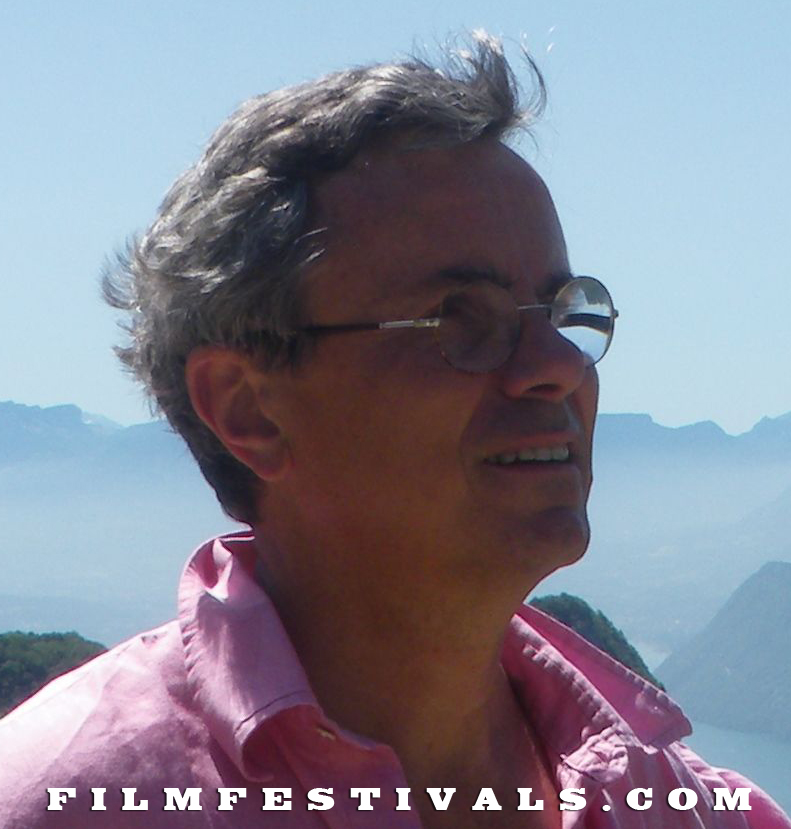
Diaspora and Armenia: interview with Atom Egoyan
Parallel Section | Diaspora - Atom Egoyan and Armenia
«The point of view of exiled filmmakers is romantic by nature.»
Interview: Thierry Jobin with Atom Egoyan
What films do exiled communities and their children enjoy watching in order to reflect on where they come from? Following cartoonist Patrick Chappatte and his Lebanese roots, the Diaspora section is making a foray into Armenian territory accompanied by Canadian filmmaker Atom Egoyan.
Atom Egoyan, knowing your work, it’s easy to imagine that your choice of films for the FIFF was influenced by a well thought-out perspective…
Yes. I could have obviously chosen films directed by great Armenian filmmakers like Hamo Beknazarian or Henrik Malyan. Without forgetting someone like Artavadz Pelechian, of course. But instead – not to take anything away from those names and Oksana Mirzoyan’s short film 140 Drams(2012) pays homage to the new generation – I deliberately chose five feature-length films made by outsiders who went there to film. Sergeï Parajanov, for example, was born in Kiev and created a large part of his remarkable work in Ukraine. He went to Armenia, where his family comes from, to film Sayat Nova (1968). And you can feel it: it’s an uplifting masterpiece from someone rediscovering his own culture. I see an obsession in it and an exile’s point of view. You have to remember that, for years, the cultural capital of Armenia was Tbilisi. In a certain way, Armenians have always lived within other empires: the Ottoman Empire, Russia, etc. And the Armenian diaspora existed long before the genocide. So we can view the notion of diaspora as having fully participated in the evolution of Armenian culture. Which creates, as in Sayat Nova, a very specific point of view, romantic by nature, full of contrast and tension.
Contrast and tension that are also found in your films Calendar (1993) and Ararat (2002) – films that you have likewise chosen for this section. Why did you choose two of your own films?
You said it: because the first thing I looked for were radical expressions of this type of contrast and tension. For Calendar, which was my return to my roots but a place I had never lived, I chose to explore – with the minimal money I had available – a road both experimental and homemade. At that time, twenty years ago, Armenia was going through its worst economic crisis. There was no electricity. The country was still in limbo. If we were to go back there today, the same places would be full of tourists. Then in Ararat, I was looking to describe how the trauma continues to affect people almost a century after the genocide. The public was probably expecting a broad film that told the story once and for all, making people admit to what happened. And I didn’t give them what they were waiting for…
It’s a bit like recognition of the Armenian genocide was lacking a film that produced the kind of effect of Steven Spielberg’s Schindler’s List (1993), which revealed the Holocaust to millions of Americans. And the reception of Ararat perhaps suffered because of it.
That’s exactly it. Fewer and fewer people read Primo Levy or Anne Frank. The vast majority don’t go looking for images from the past either. They want what’s new. Yet that unfortunately says a lot about the true place of film and images in our society. And that’s the big problem for Armenians: we have neither documentary images nor words from the likes of a Primo Levy to inscribe our story on the consciousness of the 21st century. Armenian filmmakers know this all too well. If I’ve included two of my own films and people are surprised by that, it’s because I also want to highlight this instability –that of our memory through images.
Your colleague Robert Guédiguian must have thought about these issues. For years, he pushed off this encounter with his roots before filming Armenia (2005).
It’s one of the most difficult challenges for anyone coming out of the diaspora. In Ararat, you can say that Charles Aznavour more or less embodies Henri Verneuil. Now, remember, Verneuil waited until he was 70 years old to finally allude to his Armenian roots and the genocide. It was supposed to be the film of his career. But you can’t say that Mayrig (1991) is a masterpiece. It’s hard because a project like that almost never lives up to the expectations it provokes. Guédiguian, in my opinion, was much more successful, particularly thanks to a more direct, generous, accessible narration. Having just attempted a film in the present, past and future with Ararat – a film that takes on too much, in my opinion –I felt joy watching Armenia. I had a similar feeling watching Braden King’s Here(2011), which offers, once again, a really interesting outside point of view. A land-mapping engineer that explores Armenia to document what remains: such a beautiful idea!
Looking at your trajectory, what’s striking is that your passionate interest today for Armenian culture came about late in life.
I was born in Egypt and my entire family immigrated to Canada when I was two years old… On my father’s side, my grand-father and my grand-mother were genocide survivors while my mother’s family had been living in Egypt for a longer time. But we were never Egyptian citizens. We were registered, but it wasn’t really an official document. It was only in Canada, in Victoria in British Colombia, that we finally got real identity papers.
And you first and foremost tried to assimilate to Canadian culture at all costs.
That was my whole life. Until I turned 18. That’s when I arrived in Toronto for school. And when I discovered at that I didn’t know anything about a whole part of my history. That literally overwhelmed me.Until that point there hadn’t been any expression in your family about its origins? Of course there had been. We had books about painting, in particular. My parents loved painting and painted in their free time. So I was very aware of my family’s cultural side. What I wasn’t aware of, was the historical context or the importance of the church.
What clicked for you in Toronto that you suddenly had this thirst to know about your Armenian roots?
At university, the Anglican chaplain, Harold Nahabedian, was actually a converted Armenian priest. He allowed me to learn everything: to read, to write, to understand the history…
Why didn’t your father manage to fill this role when you were younger?
Because Nahabedian had stayed passionate about Armenia. My father had a different experience. When he was young, he was lucky enough to study at the Chicago Art Institute. He found himself surrounded by abstract and impressionist thought. And when he came back, he was shocked by the feedback from the Armenian community in Cairo: why go so far away to learn to paint like a child?! After which his relationship with his Armenian roots became complicated. Extremely complicated. In the ‘70s, he went to Armenia and in front of the monument dedicated to the genocide victims, the Tsitsernaskaberd in Yerevan, he literally collapsed. He sometimes talks about what happened, saying it was as if the ghosts of the past overcame him. As if all his years of denial came back to him with violence. I remember it so well: he returned to Canada completely changed. Now he cries when he hears, in Ararat, one of the songs that his mother used to sing to him.


