Dhuud, Review: Too much of foreplay, too little of climax
Dhuud, Review: Too much of foreplay, too little of climax
Never mind if a film has no star cast. Never mind if it is made on a low budget. Never mind if it is in a regional language, and one has to read the English sub-titles quite often, to keep abreast. Never mind if it is set in a barren landscape, a desert. Never mind if it has only a handful of characters, with one of them mentally challenged. Never mind if there is no heroine and no romance. Never mind if it is does not have funny moments or other stock relief scenes. But I do mind when the film moves at a crawling pace, taking pains to establish a decadent society by repeated situations, which make the 97-minute film seem much longer than its length. And I do mind, strongly, when, after establishing the characters in a thin storyline, over 90 minutes, the writer-director then unleashes a climax of Shakespearean tragedy drama in the last 7 minutes, with several twists undulating in rapid-fire style.
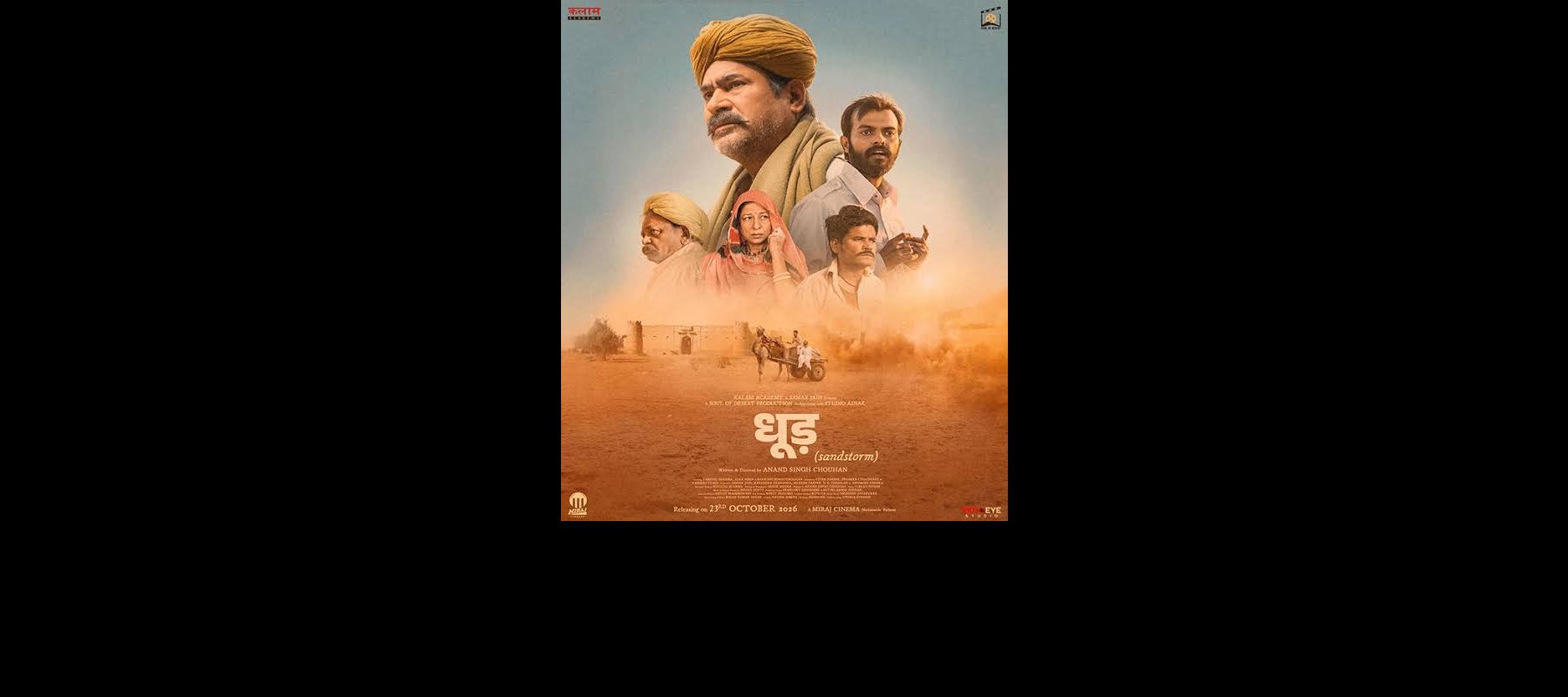
Meaning sandstorm in Rajasthani, Dhuud (sounding similar to ‘dhool’, which means dust in Hindustani) would have possibly worked as a short story. But as a film, it is laborious and repetitive, with the sandstorm rising in the very last frames. It has sparks of directorial brilliance, completely credible characters, sticks to its bare plot, without any unnecessary divergence, has near-perfect casting, which result in solid performances, and yet emerges as a case of wasted opportunity and unrealised potential. It is the first Rajasthani-language film to get a pan-India theatrical release, so expectations were high, which adds to the disappointment of it being a let-down.
Set in the1990s, in the Thar desert, over 200 kms away from Jodhpur city, in Rajasthan, with two other towns at its borders: Jaisalmer and Nagaur, Dhuud heightens the isolation of the family at the centre of this drama, by locating their ‘haveylee’ (manor) far from any other dwelling. A landlord, Bheem Singh, who had served in the 1971 war against Pakistan, rules over his ‘nuclear’ family, consisting of his demented son, his sister-in-law (his late wife’s sister) her husband and their son. He owns the entire area around his haveylee, including cultivated land, and possesses a single camel-cart as well as a four-wheeler. Twenty-five years ago, a double tragedy struck his life, when his wife died in childbirth, and the son she gave birth to turned out to be mentally challenged. Bheem Singh is now a heavy drinker and constantly prays to Goddess Chamunda to help him get his son married. Unless Sumer is married and fathers a male child, the clan will end with Bheem Singh. Apparently, he has no brothers. But who will marry a ‘retard’?
Bheem Singh has to depend on the other inhabitants of his manor—his sister-in-law Daakhu, his sister-in-law’s husband Lichman Singh and their son, Shravan, who is two years older than his own son, Sumer--for everything. He feels indebted to them, and treats them well. While his son is the butt of ridicule by the other boys around, the other young man nurses both greed and ambition. Trusted unconditionally, he often short-changes the landlord, and even resorts to stealing goats from other peoples’ stock. Invited to the wedding of another villager’s son, he finds the occasion rubbing salt into his wounds. One day, when his ‘cousin’ takes him to the rivulet from where the family gets its supply of water, the son hallucinates and gets swept away by the waves. He is luckily saved, in the nick of time, from drowning. Then, one day, his sister-in-law’s husband manages to find a girl, Ratan Kanwar, in another village whose family agrees to the match, and he is overjoyed.
The very first scene, wherein the landlord, his sister-in-law’s husband and his son go to a faraway Chamunda temple, to seek blessings makes you wonder why did they have to do this at dead of night? And the pouring of liquor on the statue of the Goddess needed to be explained, for to a person not familiar with this ritual, it would appear a sacrilege. It looks visually stunning, when the two headlights of the car are the only thing visible on the black screen. But was this done only for the sake of capturing attention, to the viewers’ disbelief? Anand Singh Chohan is a debutant writer-director, most likely hailing from the same or similar landscape that he has filmed. To his credit, one does get absorbed in the atmosphere and familial inter-actions. Although having a mentally challenged man of 25 as a prominent member of the cast draws natural sympathy, we have seen many films which revolve on the plight of such persons. However, he trips when he makes the boy fire a shot from a rifle, with deadly aim. In an earlier scene, the boy is heard asking his ‘cousin’ to teach him the use of a rifle. Then, after no training whatsoever, the retarded man becomes a crack-shot!
It is not clear why his wife tells him that she was brought into this house because Bheem Singh had his evil eye on her, and this was the only way he could fulfil his lust. Perhaps the answer lies in the fleeting shot of Bheem Singh getting into his car, and Ratan standing in her home, both looking at each other. Or, it could be interpreted from a couple of hazy shots, taken in poor light, with the characters having their backs to the camera. The only back-story revealed to us is that Bheem Singh fought in the 1971 war, and his wife died, giving birth to his son. More details were needed, about him and his family. He does pretty little besides drinking heavily and worshipping the Goddess. You do have sympathy for him on account of his double tragedy, but all that happened a quarter of a century ago. His demeanour is generally stoic and he has a fiery temper. As the handicapped boy, Sumer does not need a back-story, and manages to keep the viewers engaged by his ludicrous doings and childish antics. Although he has the couple and their son as his retinue, Bheem Singh’s relations with the three are never defined. The loneliness and solitude of the handful of central characters is palpable.

It must be a great feeling for talented actor Yashpal Sharma to get top billing, even if it is in a Rajasthani film. As Bheem Singh, this Haryanvi actor slips into the role effortlessly, and evokes feelings of deep wounds and grim determination, at the same time. His vast talent, however, is never really tested, since a large part of his screen time is spent on him consuming alcohol. Excellent support comes from the other main actors too: Alka Amin as Daakhu, Vivek Pareek as Sumer Singh, Bhawani Singh Chouhan as Lichman Singh, Praveen Choudhary as Shravan and Vanikki Tyagi as Ratan Kanwar. If I remember the credit titles correctly, this is Vivek Pareek’s first film. He has a bright future. Dhuud also introduces Vanikki Singh, in a cameo that holds promise.
Dhuud is heavy going, with very little relief or entertainment. You need to be patient to let it sink in. Described as psychological drama thriller, it has a lot of psychological content, plot points of highly emotional drama, but there is nothing by way of thrills in the film.
A desert is a cinematographer’s dream as well his challenge, and Ashok Meena rises to the occasion. Mehul Surti provides the mood music. One wonders whether to put the load of a very slow pace through the first 90 minutes of 'foreplay' on the editor, Vibhav Nigam, or to compliment him on the last 7 minutes, of the climax. Of course, the director would have had his vision, which the editor only executed. The half star, after two of them, is on account of the last 7 minutes and the bravura of the makers in choosing a subject like Dhuud, at a time when mayhem is the monopoly of the Hindustani film industry.
Rating: ** ½
Trailer: https://www.youtube.com/watch?v=HPWmMXLVGnc
Coming up: Reviews of Pehla Pyaar Doosri Baar and Udta Punjab.