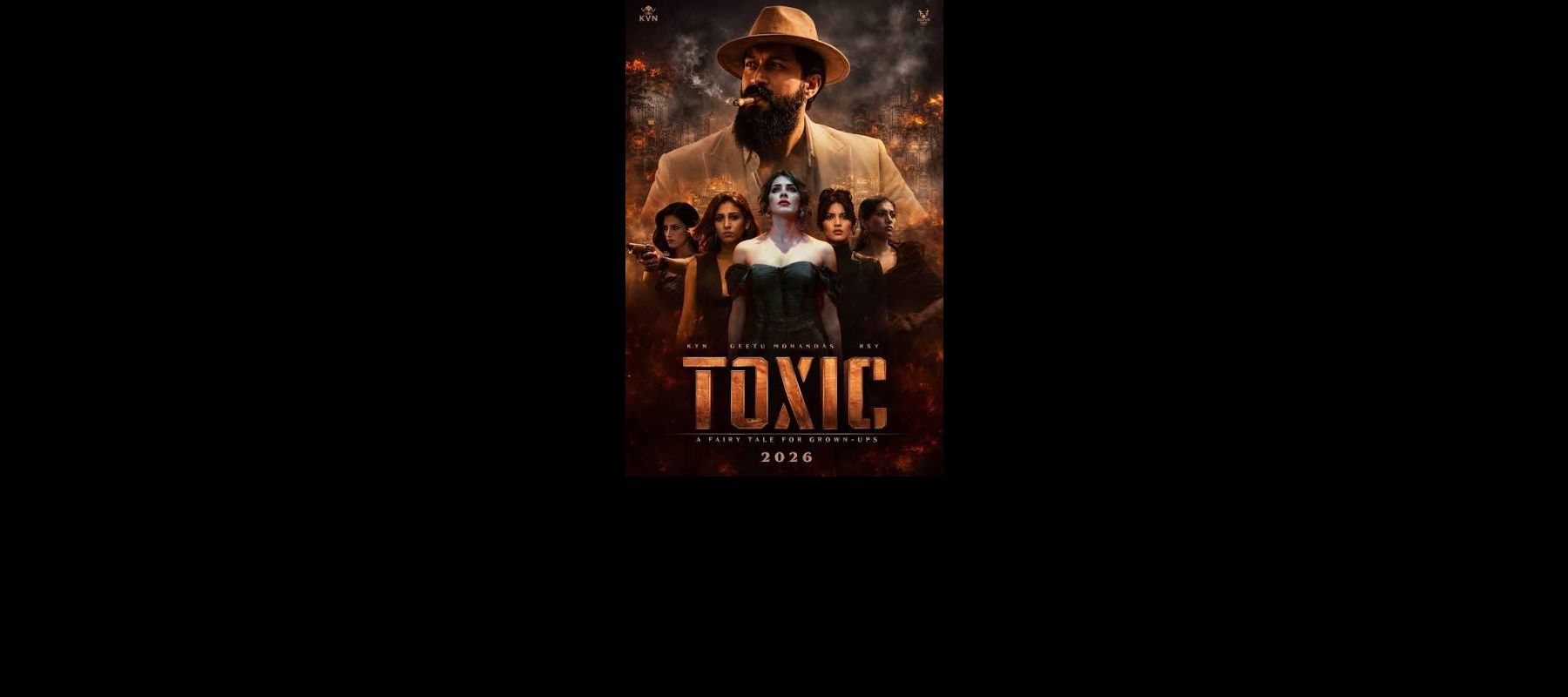
Toxic, Review: Talk Sick
Toxic, Review: Talk Sick
Lionsgate opens.
You enter, very cautiously. Who wants to be confronted with the king of the jungle?
Turns out the only two lions in the film are those that jump through fireball rings, in a circus, and they are seen only seen once.
Lionsgate happens to be one of the many producers/distributors of the film, and Toxic is not about lions.
So what is it about?
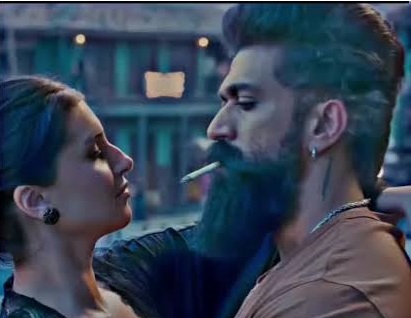
It is about a man, who smokes far too often, drinks far too much and sleeps with far too many women.
But he makes no bones of it.
In one scene, he asks one the woman, “You think I am a bad man? No. I am Toxic.”
Now we know where the title came from.
Toxic is a very, very violent film. It can be archived and cited as such to all future students of cinema.
Toxic is a very, very funny film, and must be cited as one of the most unintentionally funny films ever made.
It would be perfectly normal to believe that the fights were composed and shot first, the songs were recorded first, and dialogue written first. First, meaning before the story. Then a story was woven around this massive footage. This in reverse gear, when seen against the norm of all these components coming together afterwards.
For the fights and action scenes, a whole team was set-up to discover or invent about a hundred different types of guns, and another hundred different types of weapons. Besides, the team was to sign about 500 stunt-men and stunt-women, who would be able to execute the complicated, tricky and mass choreographed fights.
For the story, the makers did not have to look far. It came from then director herself, who is quite a name in Malayalam cinema. film Liar's Dice received two National Film Awards, and was India's official entry at the 87th Academy Awards for Best Foreign Language Film. As an actress, she has won a Filmfare award, way back in 2004, when she was 23. She has two men helping her cook-up the screenplay, one of them being the producer and hero of the film, who plays father and son, in a dual role.
The writer-director of this film is a woman? Indeed.
Is there an award for the Most Violent Film Ever Made by A Woman? If there isn’t, the Academy (USA), the Ministry of Information and Broadcasting (India) and Filmfare (a reputed publication of the Times of India group) should immediately consider instituting one, and the woman who directed his film would be a top contender.
Since there was to be SO MUCH mayhem, so many maimings, so many explosions, so many huge fires, so may decapitations...strong emotions were needed to serve as the counter-points, or the reasons for the blood and gore. There are emotions aplenty, but they have very little to do with the main plot. A woman deserted by her husband. A father who leaves his wife and young children and does not re-appear for years. A sister who raises her brother and sells her body to provide him with the necessities of her life. A woman who marries the deserter in a marriage of convenience, while he impregnates another woman. A father who cannot take the responsibility of supporting his wife and raising his children. Two boys who crave for the presence of their father. A son who is ready to face-off with his father for the trauma he subjected to his progeny. A woman who straps bombs around her chest, threatening to commit suicide if her lover spurns her. Betrayals, right and centre. A man who proclaims to a gathering that the path to confront the Portuguese oppressive, colonial government, in post- independence Goa, is through non-violent agitation, and is killed for his stand, along with the entire assembly. A sister, who wants to avenge her brother’s murder, a father who wants to avenge his son’s killer, a brother who wants to regain control of his turf from his Mafia Don brother, ….
And in between all of this, we have the songs and the philosophy that every character spouts, in every line spoken in the film, mostly as one-liners, and, occasionally, longer. Never mind that he/she might not even know the meaning of the word ‘philosophy’.
Here are some gems of philosophy that are relevant to the film.
Immanuel Kant viewed marriage as a sacred contract of mutual commitment. He argued that infidelity is wrong because it treats a spouse as a mere tool for pleasure rather than a person worthy of respect. Modern existentialists note that true love requires a conscious choice of loyalty every single day.
Simone de Beauvoir felt that authentic love must be founded on reciprocal recognition of two freedoms; each lover would then experience himself as himself and as the other.
Toxic stars Yash in a double role. As the elder character, Raya, he has no respect for the sanctity of marriage, but he does feel complete in the company of some women. As a younger brother, he is brought-up by his devoted sister.
Nel Noddings emphasised that the bond between an older sister and a younger brother is built on natural care and protection. The sister often takes on an early role of guidance, making this relationship a foundational lesson in lifelong empathy and mutual support.
Thomas Aquinas argued that war is only acceptable if it meets strict conditions: it must be declared by a proper authority, have a just cause, and be used only as a last resort. Friedrich Nietzsche warned against revenge, stating that obsessing over fighting monsters can turn you into a monster yourself. Hannah Arendt views totalitarian violence and mass killings as the ultimate collapse of human morality, happening when individuals stop thinking critically and blindly follow evil systems.
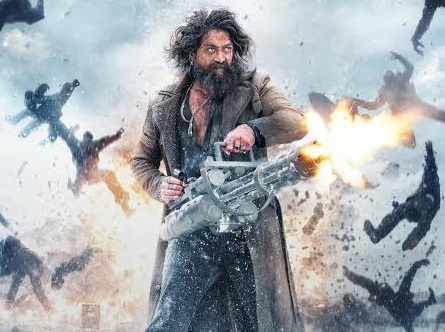
The film is full of gang wars, revenge upon revenge and totalitarian violence, often pitching Raya against an ‘army’. These armies are led by both Indians and Portuguese players.
Toxic has Akshay Oberoi as Tony, Darrell D'Silva as Salvador, Benedict Garret and Kyle Paul (Fernandez Almeida) as Raya’s opponents.
John Locke argued that a parent's primary job is to provide a loving environment and moral education, shaping how the child will eventually view and treat the world.
Toxic is about an absent parent (Raya), hostile environment and no education for the children.
Aristotle believed in the "Golden Mean"—the idea that virtue lies in moderation. Overindulging in alcohol or gambling destroys your ability to make rational choices. Epictetus argued that addiction to substances or gambling makes you a slave to external desires. True freedom means mastering your own mind and body. Marcus Aurelius believed that true freedom is internal. It is the ability to control your own desires. If you need a cigarette to feel calm or to get through the day, you are no longer a free person. You have handed your peace of mind over to a paper stick filled with leaves.
Toxic is about a man who lights cigarettes with a swagger, after every two scenes, drinks a lot of liquor, and is part of a criminal syndicate, smuggling opium to addicts.
Mahatma Gandhi argued that non-violence (Ahimsa) is the most powerful weapon for freedom. He believed that using violence to win independence only poisons the soul of the new nation. Frantz Fanon argued the opposite for deeply entrenched colonisation. He believed that colonisation is inherently violent, and the colonised can only fully break their psychological and physical chains through a violent revolution.
The writers have named Raya’s son Rumi, the 13th-century Persian poet, Islamic scholar, and Sufi mystic, whose profound spiritual writings are celebrated worldwide.
Rumi believes that freedom can only be obtained by violence. But, besides executing believers in non-violence, he does nothing to liberate Goa from the Portuguese, violent or non-violent.
Jean-Paul Sartre argued that humans are entirely responsible for their actions. He called it "bad faith" when people make excuses for their behaviour, by pretending they have no choice.
Raya’s behaviour suggests that he ascribes to this theory.
Aristotle believed that human virtue and happiness are built entirely on habits. We become good by doing good things repeatedly.
The writers and director of Toxic, Geethu Mohandas, Yash and Raaghav Vinay Shivagange have created characters, barring one or two exceptions, that do not believe in doing good things at all.
Ganga, the elder sister, believes in doing good for her young brother and Nadia, the circus performer, who hangs by a hula-hoop, swims like a mermaid in a gigantic bowl, waits patiently for years, for her man to return and knows how to keep a virtuous secret, does good. The exceptions prove the rule.
Ganga is played by Nayanthara, while Nada is enacted by Kiara Advani.
Friedrich Nietzsche philosophised that he who has a ‘why’ to live for can bear almost any ‘how’.”
Almost all the characters in Toxic seem to live lives of organised crime, making tons of tainted money and avenging deaths of their kith and kin.
These characters include Huma Qureshi as Elizabeth and Tara Sutaria as Ganga.
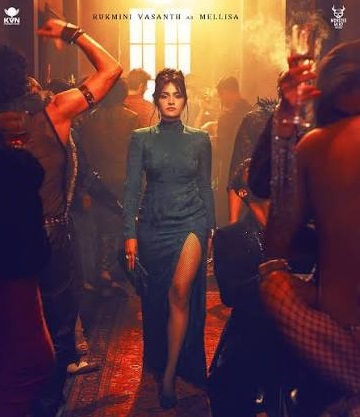
Others in the cast are Rukmini Vasanth as Mellisa, Sudev Nair, Balaji Manohar, Beatriz Taufenbach, Surjith Gopinath, Amit Tiwari, Tetiana Gaidar, Harish Bharamagiri, Kaushik Desai, Rajiv Kachroo, Parminder Singh Kainth, Elian Maffioly, Samir Patel, Vikash Rai and Sanjeeda Sheikh (special appearance).
Toxic, however, is not a film about any kind of philosophy at all. The story meanders like an aeroplane without a pilot. Characters and their relations to each other are never really established, so you have to constantly try and fit the jigsaw in your brain. It is a feast of violence, wherein a woman writer-director, with the help of two men in the scripting department, has proven that if men can make films with 1,000 killings, she can have 3,000 of them. If male directors have their heroes pumping 3,000 bullets, she will move to the figure of 9,000. If other action films in recent years have shown killings with body parts chopped off, including decapitations, she will add knives being thrust into rivals and pulled out with blood dripping in mid-close shots, for a lot of cinematic time. If blood-letting has so far been confined to a few litres, she will raise the bar to thousand litres. If other block-busters from the South have shown bad guys being impaled, they will pale into comparison when they see objects piercing bodies right through, so many times, that one will lose count. Besides knives, hammers and axes, she will add a host of other objects that can be used as weapons.
Actors have to go through the three main emotions of anger, moping and killing. They have done what they were told to do.
As the combined efforts of Vishal Mishra, Ravi Basrur, Tanishk Bagchi, Faheem Abdullah and Arslan Nizami, the music is of good quality, with two songs rendered with deep feelings.
With the camera moving from circuses to casinos to graveyards to icebergs to underwater to aeroplanes to parachute landings to a church to cars hurtling at breakneck pace to the same actor fighting himself in a double role as father and son, cinematographer Rajeev Ravi cannot be faulted. Now, should we blame editor Ujwal Kulkarni for the insufferable length of 194 minutes, or should we blame it on the crammed content, the countless characters and hundreds of scenes, at least 30 of them eligible for excision? Tough one, that!
Toxic begins with a Voice Over in a falsetto, deep, gruff grainy voice, which, you realise after a while, could be that of Raya (I am not saying it is Yash’s voice, because we were shown a version dubbed in Hindi, with a generous dose of English and a smattering of Portuguese). That tone is retained throughout the film. Dialogue is as pretentious and indulgent as can be, and sticks out like a sore (or chopped off) thumb, often drawing guffaws, giggles and chuckles, where it is supposed to be menacing or profound.
They call it “A Fairy Tale for Grown-ups.” That’s sick talk. Or, Talk Sick. Pun intended.
Rating: *


