
Interview with Russian maestro Aleksander Sokurov at Venice Film Festival
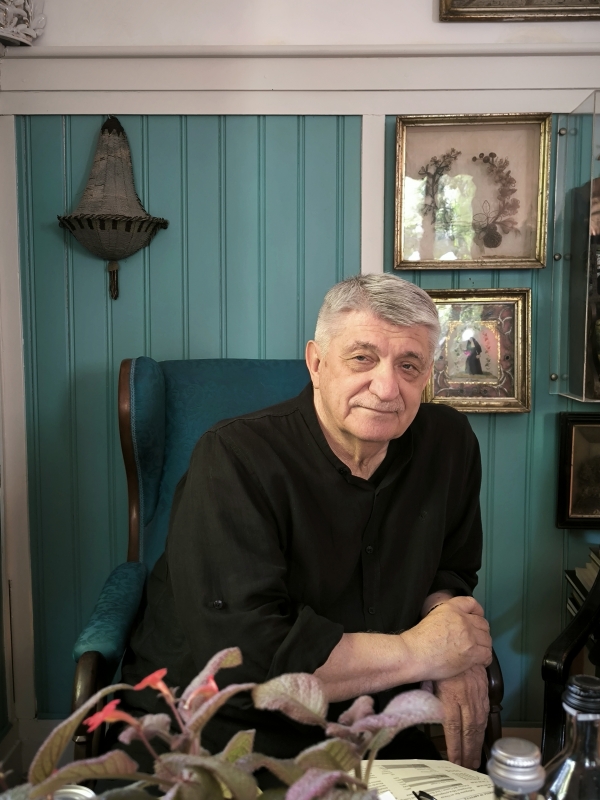
Aleksander Sokurov at the interview
A. Sokurov: Despite the challenges faced by cinema in the 20th century, I see this film as a love letter to the past 50 years, reflecting both my personal experiences and the broader history of humanity. This is the first film in which I participate not just as a filmmaker but as a character, someone deeply connected to the story. Many of the events depicted on screen are things I witnessed myself. The people in the film, my compatriots in every sense, may not share my views, but I love them all. I may disagree with them, but my affection for them remains.
In the film, I explore how socialism, as a societal model, slowly faded. Though this period was not entirely successful in Russian history, I regret the loss of that opportunity. Even if the socialist era of Soviet history wasn’t ideal for the people, I feel a tinge of disappointment. This isn’t just about losing a political system. For centuries, people dreamed of equality, and Russia was given a chance to realize that dream. Yet it didn’t succeed. The dream of equality, French utopian socialists like Saint-Simon, Fourier, and Owen, captivated us all. They envisioned a “City of the Sun,” a utopian society. No nation had truly attempted to bring this vision to life until Russia did.
At first, it seemed promising, but it quickly became challenging. The difficulties grew, compounded by Europe’s aggressive reaction to Soviet Russia’s efforts. Did Europe support this attempt to build an ideal society? No, they tried to stifle it.
A. Kanterian: Can we say that this is a continuation of the Russian art?
A. Sokurov: So, at least in the part that Russian art was a kind of artistic issue. And this film is not a newspaper, newsreel, and it's not a study. This is a reflection on the time.
A. Kanterian: What I noticed in the film, with my Western eyes, is, of course, it presents a very particular history of the Soviet Union. And the Western history, of course, as well. But what caught my eye were a couple of omissions that were very obvious in the film. For example, that the year 1986, which is a very watershed year for the Soviet Union, at least in the Western world as we perceive it, was completely omitted from the film. 1986. Yes. So could you explain a little bit about those kind of decisions?
A. Sokurov: This was a deliberate choice. I analyzed each year for its dramatic potential. If a year lacked compelling events or content, I excluded it. It’s a personal point of view and it very personal understand perception of the time. The first version of the film was seven and a half hours long—hardly suitable for a theatrical release. After careful consideration, I cut it by two and a half hours, and I’m satisfied with that decision.
This film demands to be seen on a big screen. The size of the screen has a profound emotional and psychological impact, enhancing the sound design and visual composition. A larger screen amplifies the film’s emotional power, immersing the audience fully.
A. Kanterian: But you were also, I felt the thing that it's a kind of tribute to the editing. How much you were inspired? How much you were inspired by the Russian school of editing?
A.Sokurov: As for editing, I don’t believe in a distinctly Russian, American, or French school of editing—it’s an illusion. Editing is the work of individual creative authors. Take El Greco: is he a Greek painter in Spain or a Spanish painter of Greek origin? He is simply El Greco. Editing draws from personal intuition and global experience. While there are conventions, I follow my own instincts. Each film is a new challenge, requiring freedom and independence. What captivated Griffith or Eisenstein may not resonate with today’s audiences. Every filmmaker must forge their own path.
A. Kanterian: Why does the film begin in 1957?
A. Sokurov: It’s no coincidence. Stalin’s death in 1953 marked a turning point, but it took years for Soviet Russia to recover from his regime. By 1957, people began to breathe more freely, moving past the devastation of World War II—a catastrophic event for the Soviet Union, as it was for others. I came across a book, published in a small print run by military lawyers, detailing the atrocities in the Pskov region, an area as large as Spain. They found no survivors—every city and village was destroyed, the population annihilated by German, Hungarian, and Spanish soldiers. The graves were piled three to five meters high with victims. We used to discuss about Shoah, which was a horrific event of World War II. And no one raised to the question of how many Russian people was killed because of respect for the tragedy of Holocaust. But it was a giant loss. They killed this. It was Hungarian German and Slovak soldiers who fight on the German side in this territory. Russia still bears the trauma of this history, and it will take three generations to heal.
A. Kanterian: In your film you talk a lot about censorship. My question is how one makes films under censorship and films that matter, that matter and not like just fairy tales and escapism in films.
A. Sokurov: Regarding censorship, it’s a dire situation. Censorship is banned by the Russian Constitution, yet it persists. This film was made with private funds, without state support, and I fear it won’t be released in Russia. Many of my films, including Russian Ark, are banned there. I long to connect directly with my compatriots, but the reality is challenging.
A. Kanterian: You mentioned a lot of filmmakers and films in the film. Those filmmakers were a source of inspiration for you as a filmmaker?
A. Sokurov: The film has many references, to many filmmakers and their works, who are indeed sources of inspiration. Masters like these hold immense value for me, regardless of ideological or stylistic differences. Craftsmanship in cinema is rare and deeply respected.
I actually wanted to continue this question about masters. The film features masters you studied, but also those who inspired you. I'm thinking of Yevgeny Yufit. Why did you decide to include him in the film?
Because it's part of this hell. Because he studied at my film school, which existed for a short time, and I considered him a very talented person, and the material is there. And I wanted his memory to be preserved (unfortunately he’s passed away). Because this is a specific part of the film, when there's a young artist. Was this in the '88s? Yes, in the early '90s. These were real avant-garde, real fighters who wanted to work. Yevgeny Yufit and others. There were seven people there.


