
Nina Mehta’s 6th Death Anniversary (12th April 1942-26th April 2014)

Nina Mehta’s 6th Death Anniversary (12th April 1942-26th April 2014)
They were the earliest ghazal-singing couple I knew, Nina and Rajendra Mehta. Ladies come first, was the rule back in the late 60s. Born into a Baroda-rooted Gujarati business family, Nina Shah studied at Wilson College, Mumbai, where the family had settled. Winning the Inter-Collegiate Singing Competition four times in a row, she made her radio debut in Ovaltine Phulwari, which was a singing talent weekly show anchored by Ameen Sayani. (The programme later metamorphosed into Cadbury Phulwari).
It was time to take music seriously, and the family easily agreed. To be sure, the Shahs were a musical family. Brother Sudhir took-up the sitar, brother Shrikant tried his hands at the tabla, and in Niniben, they had a sister who sang. Sister Shridevi is an artist for sure, but more in the fine arts field. It was the early 60s, and Nina Shah had found a teacher in Ustad Hafiz Ahmed Khan, of Delhi. Soon, she found a suitable boy too, a man who could sing soulful ghazals and even taught her to pick the nuances of this specialised light/light-classical Hindustani music form. Till then, she had specialised in Gujarati light music. But, as she said herself, it was his voice that sent waves to Nina’s heart, which began to beat faster at his first ‘alaap’.
In 1963, Punjabi-speaking Rajendra Mehta, who loved the Urdu language, and to sing ghazals, met Nina at the All India Radio (AIR) studios, in Bombay. Her Ustad, Hafiz Ahmad Khan, had asked him to record a ghazal with her. When Rajendra met Nina at AIR, the two singers matched each other as well as the two matlas in a sher. The two lives came together like a ghazal, and they were married in 1967. I knew nothing about all this when I got acquainted with Sudhir, Shrikant and Shridevi, as part of a youth club, just about then. We had meetings at the Shah family’s flat on Peddar Road. Naturally, this brought me in contact with Nina too, who we all called ‘Niniben’. Strangely, her husband was ‘Rajenbhai’ to all of us.
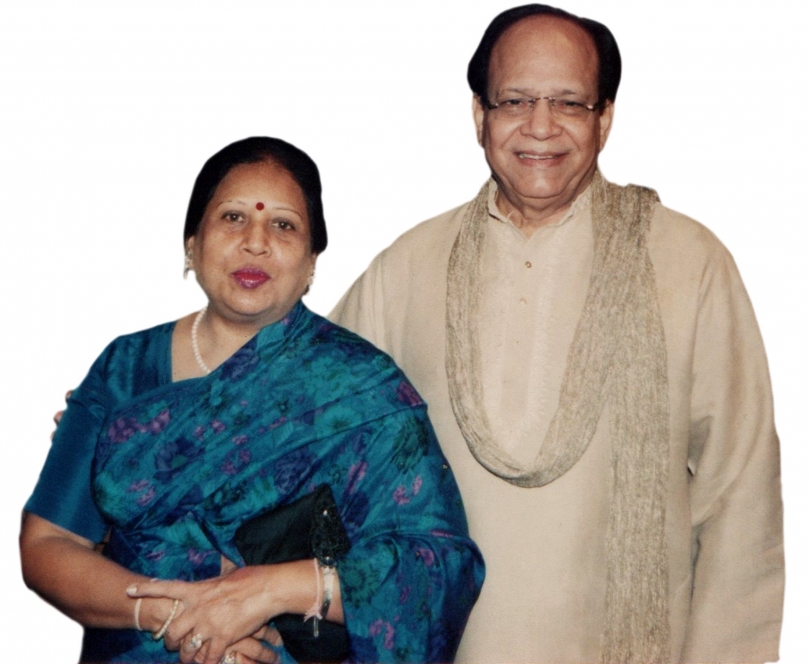
Nina was soft-spoken and affable, modest and hard-working. She had a challenge at hand, gaining proficiency in Urdu, but she made the cut. After Hafiz Ahmed Khan was transferred to Delhi, Nina learnt under Pandit Govind Prasad Jaipurwale and Ustad Abdul Rehman Khan. And over the years, I got to know the Mehtas quite well. In fact, for a while, I was part of their ‘troupe’.
The duo reposed tremendous faith in me by asking me, barely out of my teens, to compère some of their earliest concerts. Three delicate, sensitive, sentimental duet numbers that bore the Mehtas’s stamp and just had to part of many Nina-Rajendra ghazal nites: ‘Taj Mahal men aa jana’, ‘Shaam-e-alam jab dard-e-judai’ and ‘Alvida O sanam’. LPs, cassettes and CDs followed, in large numbers, both solos and duets adorning each compilation, live recording or studio product. Foreign tours became eagerly awaited events. They were a regular fixture at Music India’s annual ghazal extravaganza, Khazana. But come the early 2000s, and Nina’s health began to crumble. Rajenbhai was forced to sing alone, after 36 years of dual performances, and though he tried very hard to continue the good work, even his health began to give way. Age was not going to spare him either.
Six years ago, this day, providence, family, friends and Rajenbhai bid good-bye to this gentle soul, who must be, even as it took flight, humming, ‘Alvida, alvida, alvida, O sanam.’ Rajenbhai was to follow, in 2019. They were nice people, and among my first mentors. Now they are resting in everlasting peace, in a Taj Mahal that is above any monument, a symbol that was very dear to them.
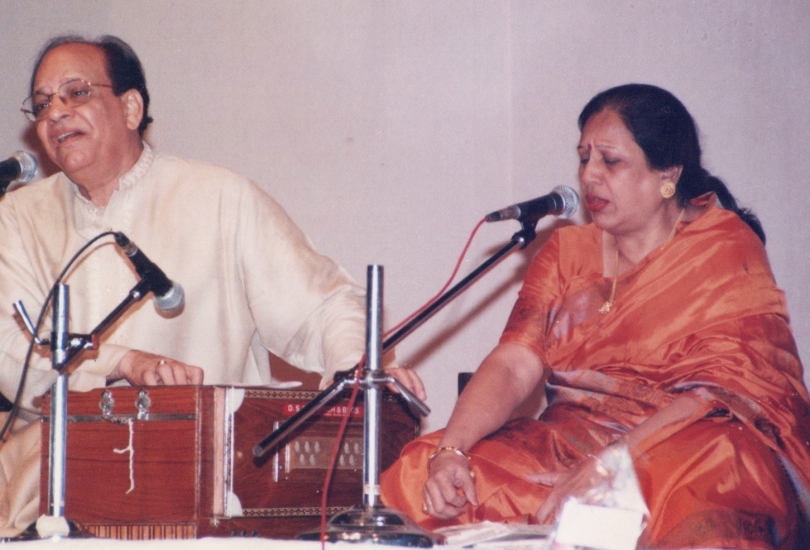
Nina said in an interview that to them, poetry came first, poet was secondary. Among the shairs whose kalaam they showcased were: Jan Nisar Akhtar, Bashir Badr, Rajesh Reddy, Sardar Anjum, Shakeb Banarasi, Kumar Shailendra, Mumtaz Rashid, Kaifi Azmi, Qateel Shifai and Sudarshan Faakir. Though a large oeuvre of Urdu poetry comprises wine and lust, these elements were anathema to Nina and Rajendra Mehta, who eschewed them emphatically. Nina and Rajendra Mehta’s departing is a great loss to both serene music and tasteful Urdu poetry.
Nina and Rajendra unfortunately lost their daughter Neera, a very gregarious and generous person, in 2008. They are survived by Neeraj, their son, who is a well-known cinematographer, based abroad, and has won international awards.
Pictures are courtesy the Shah family. The LP cover picture is from my personal collection.
You can hear Nina Mehta singing the pathos-tinged ‘Humsafar saath saath chaltey haen’ from the same LP of live recordings, at Khazana 1984, courtesy Universal Music, on https://www.youtube.com/watch?v=iQwwDncffCQ


