MIFF 2020: “Why can’t we appreciate off-camera sounds?”—B. Lenin

MIFF 2020: “Why can’t we appreciate off-camera sounds?”—B. Lenin
Son of legendary director-editor A. Bhimsingh, B. Lenin started his editing career at the age of 18, in 1965. But guess what he wanted to become as a young boy? A projectionist! Why? Read on.
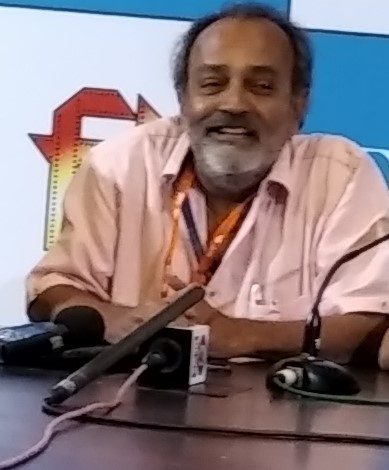
“I am one of eight siblings and saw very little of my father as a child, because he used to work around twenty hours a day. When he came home, sometimes at 4 am, I would ask my mother who this man was. We children began to address him as ‘Director’. The raved director of hit films like Aadmi and Gopi (Lenin assisted his father in editing) wore simple clothes and was unassuming. I loved watching films. My favourite two cinemas in Chennai were Prabhat, about 12 kms. away from my home, a distance that I had to walk, and Star. Prabhat showed the films made by V. Shantaram. While watching the films, I used to believe that the film is made by the projectionist and he makes people act. So, I decided that I would become a projectionist when I grew up.”
Talking about his teenage years, he elaborated, “The films I grew up on were Do Aankhen Barah Haath, Bandini, Sujata, and other works of directors like V. Shantaram and Bimal Roy. So fascinated was I with Shantaram’s work that I ran away from home, to come to Mumbai, and meet him. From my mother’s side, I am half-Maharashtrian, and coming to Maharashtra was something special for me. Somehow, I managed to reach Shantaram’s Rajkamal Kalamandir Studios, where I met recordist Mangesh Desai. Desai was kind to me, and I spent the next six years of my life living in a small room, next to the canteen. My idols have been V. Shantaram, Satyajit Ray and Mrinal Sen.”
Asked to share details about the National Award for Best Editing, which he won jointly with V.T. Vijayan, for the Tamil film Kaadhalan (1994), one among his six National Awards, he responded, “As expected, the headless wonder song in the film, picturised on Prabhu Deva, was the talking point. A member of the Awards Committee asked me whether I had cut the head from each individual frame, and I nodded. Fact is, I did something else, but I let the member feel happy at having guessed my technique. I would have shown you how I did it, if we had the facilities here. You will not understand if I just spoke about it.”
On new technology which has dispensed with editing tables and replaced them with computer work-stations, he opined, “It’s no big deal. We editors are like logs in a river, and float to our destinations, any which way. Yes, cutting has become frenetic and where we would have had two-or three shots, we might have twenty or thirty, these days. But understanding and creativity are largely missing. Where are the pauses that defined Dilip Kumar’s dialogue delivery? Where are the phonetics that I learnt from Richard Burton, in Becket? Why can’t we appreciate off camera sounds, where the source is not shown? Have you seen the film 1917? We get the impression that it is a single take film, which it is not. Actually, the film (2019; director Sam Mendes, editor Lee Smith) has been so well conceived and executed that we flow with the story, believing that the entire film was shot as one take,” Lenin concluded.


