
MIFF 2016: National Jury speaks its mind
MIFF 2016: National Jury speaks its mind
Films in the competition section at the Mumbai International Film Festival (MIFF) are divided into three main categories, national, international and Public Service Advertising (PSA). A five-member jury viewed the 27 films in the national category, and, after completing their task, met the press at the Media Centre, on 02 February, Tuesday.
Two of them--internationally acclaimed wildlife film-maker Mike Pandey and Taiwan-based festival programmer and film-critic, Jane Yu, Director of the Asian Cinema Fund, Busan International Film Festival--had already left. Mike, whose grandson had taken ill and he had flown to New Delhi to be with him, had spoken to a Delhi-based journalist and offered to communicate via video link, but that was found to be impractical by the organisers.
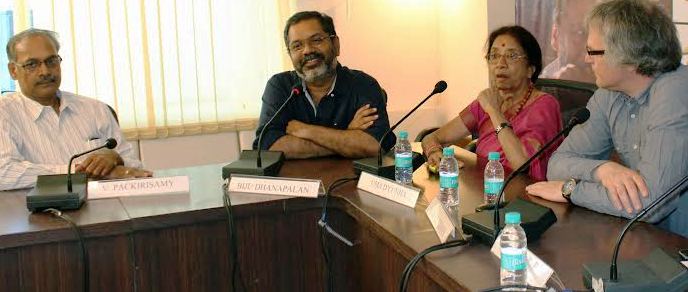
The three other jury members were present: Audrius Stonys, Lithuania-born academician, who lectures on cinema in many cities, including DocEdge Kolkata; Indian programmer, journalist, researcher and casting director Uma Da Cunha and Biju Dhanapalan, an engineer-turned-visual effects specialist who worked on over 100 feature films in India before re-locating to Singapore, where he currently teaches animation. Also present was Mr. V. Packirisamy of the Films Division, the national jury co-ordinator, who provided some facts and figures.
“A mix of brilliant and bad,” is how Dhanpalan described the films seen by the jury. Stonys pointed out that even if there were just two outstanding films at a festival, it should be considered a very good festival. “At MIFF, we saw at least four great films, and another 10-12 high-grade efforts. Indian documentaries have always been by and large good, but till a few years ago, the cinematic language they used was very Indian. Now, these films have crossed that hurdle and their style can find place in any international film festival.”
Da Cunha complimented the Films Division for spending two years putting MIFF together. However, she added, “It should be made an annual event and should be organised on a bigger scale.” Replying to a question about how MIFF compares with other film festivals, like Cannes or Venice, she commented, “It is unfair to compare it to Cannes or Venice. So many factors should be considered before evaluating a festival—how old is the festival, base city-funding or lack of it and other sources of financing, prizes and prize-money, etc. But let me assure you that a prize at MIFF has its own special value.” Dhanapalan was of the view that it is the talent that defines a film-city. “Hollywood just happened because people of various nationalities were attracted to the place, to work in the film industry. Blockbuster director Peter Jackson did the same for his native New Zealand. If we can attract excellent talent, there is no reason why India cannot surpass Hollywood.”
Asked how our documentaries were faring internationally, and is co-production a growing trend, Da Cunha revealed, “Indian documentaries have won so many awards internationally. By comparison, our features have worn hardly anything in recent years. And yes, co-productions are a great was to get funds and reach bigger markets.”
On a question about budgets, Stonys said, “Budgets are not an issue in India. Yes, some self-funded documentaries are below par and cannot be marketed as a result. But generally, Indian documentaries, like MIFF itself, have a very good reputation in the world. All that is needed to make even better films is quality education, and a much larger number of regular film workshops.”


