

Camerimage Film Fest to present Emeric Pressburger and Michael Powell Retrospective
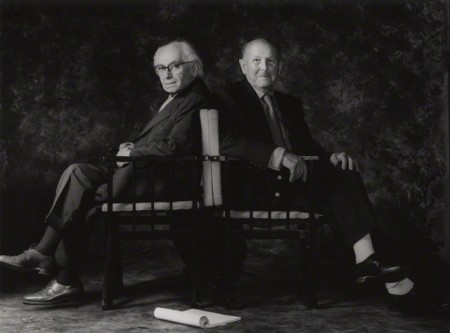
Emeric Pressburger and Michael Powell
CAMERIMAGE, the International Film Festival of the Art of Cinematography, reveled today that it will host a special retrospective of the films made by Michael Powell and Emeric Pressburger, the famous filmmaking duo whose work has been great inspiration for many acclaimed artists of worldwide cinema. In celebration of their work, the festival will be joined by special guests: Michael Powell's wife and three-time Academy Award® winning editor Thelma Schoonmaker, and two film scholars and experts in the cinema of Powell and Pressburger, Erich Sargeant and Ian Christie.
Said Christie, "Forty years ago, the films of Michael Powell were all but unknown, almost impossible to see in anything like their original state, and seemingly irrelevant in the era of the ‘new Hollywood’ of Spielberg, Coppola and Scorsese. But by the early 1980s, a revolution in taste was underway, and audiences around the world began to discover The Archers, Powell and Pressburger’s joint signature from 1942–56, while some of Hollywood’s new aristocracy declared themselves devout fans. Truncated films began to be repaired and faded colour revived, with The Archers’ films setting new standards in restoration right up to the unveiling of a spectacularly restored The Tales of Hoffmann at the Venice Film Festival earlier this year.”
Films that will be screened at Camerimage include:
· The Edge Of The World; 1937; cin. Monty Berman, Skeets Kelly, Ernest Palmer
· One Of Our Aircraft Is Missing; 1942; cin. Ronald Neame
· The Life And Death Of Colonel Blimp; 1943; cin. Georges Périnal
· A Canterbury Tale; 1944; cin. Erwin Hillier
· 'I Know Where I’m Going!'; 1945; cin. Erwin Hillier
· A Matter Of Life And Death; 1946; cin. Jack Cardiff
· Black Narcissus; 1947; cin. Jack Cardiff
· The Red Shoes; 1948; cin. Jack Cardiff
· The Small Back Room; 1949; cin. Christopher Challis
· The Tales Of Hoffman; 1951; cin. Christopher Challis
· Peeping Tom; 1960; cin. Otto Heller
Emeric Pressburger and Michael Powell
What has given them this extraordinary second life? It started with the unlikely partnership of an Englishman who only seemed to have a traditional ‘stiff upper lip’ and a Hungarian refugee who loved and understood England better than most of its natives. This was not so surprising, since it was another Hungarian, Alexander Korda, who brought them together in 1938 as a small part of his ambitious mission to put Britain on the world cinema map. The result was an unusual thriller, The Spy in Black, starring the great German actor Conrad Veidt, which caught the anxious mood of the time on the eve of what would become the Second World War.
Powell had already shown his ambition by leading an expedition to film on the remote Scottish island of Foula in 1936, which produced The Edge of the World, a film that now seems to anticipate some of the romantic themes that would underpin his joint work with Pressburger. But it was the war that had not only brought Pressburger to Britain, having abandoned his career in Germany when the Nazis came to power, but also gave the Powell-Pressburger team the challenges they needed. One of Our Aircraft is Missing, The Life and Death of Colonel Blimp and A Canterbury Tale all took everyday wartime experiences – bomber crews baling out, home defense organization and allied troops stationed abroad – and transformed them into profound meditations on the values at stake in the war against Nazism, and what ‘Englishness’ meant in these testing times. Often paradoxical, playing up stereotypical characters – like the venerable Colonel Blimp, already a popular cartoon figure at that time – in order to challenge them, they found the propaganda imperative a stimulus to invention.
The Archers also prided themselves on looking ahead, speculating about what audiences would be interested in a year ahead, and their two final wartime films, I Know Where I’m Going! and A Matter of Life and Death, both dealt with the challenge of peace. In one, a very modern young woman learns humility amid an ancient way of life in the Hebrides; and in the other an English pilot and an American servicewoman become characters in a supernatural allegory about their countries’ historic relationship, set in the operating theatre and in heaven.
British filmmaking had reached new heights during the war, but the post-war climate was bleak. The Archers caught the spirit of neo-romantic artists in other media, and created a series of spectacular melodramas, starting with Black Narcissus, set in the emotional cauldron of a Himalayan convent and acknowledged by Hollywood as a Technicolor masterpiece. The Red Shoes followed, pushing beyond the confines of the musical romance to visualize both the outer and inner world of dance; and its influence would also be vast, even as it perplexed critics in search of sober realism.
The sheer confidence and craftsmanship of these films is still astonishing, and belies the difficulties that Powell and Pressburger faced at the end of the 1940s. The Small Back Room now looks like a British-style film noir, ahead of its time. The Tales of Hoffmann, taking the fantasy world of The Red Shoes even further, seemed equally out of step with the spirit of post-war modernization. The Archers' partnership dissolved in the mid-50s, as Powell and Pressburger each sought different creative paths in a film culture increasingly hostile to their values.
Then came Peeping Tom, written by an ex-spymaster, and directed with panache by Powell as both a satire on the British film industry and a personal testament. Reviled by most of the contemporary critics, this became a cult among younger film enthusiasts in France, Britain and America – leading some, like Scorsese and the present writer, to start discovering what lay behind its bold provocation. The rest is a chapter in modern cinema history that’s still being written, as audiences continue to discover the magic of The Archers.
About CAMERIMAGE
Now in its 22nd Edition, the International Film Festival of the Art of Cinematography CAMERIMAGE is the most recognized festival dedicated to the art of cinematography and is the biggest international film festival in Poland. The unconventional format of the Festival, which awards films according to their visual, aesthetic and technical values, is a unique alternative to traditional film festivals.
CAMERIMAGE proves to be a great forum not only for presentation but also for further development of international moviemaking and provides a platform for young filmmakers to explore new artistic areas.
In addition to the Main Competition, the Festival offers a 3D Films Competition, Polish Films Competition, Student Etudes Competition, Documentary Films Competition, Feature Debuts Competition, Music Videos Competition, Camerimage Market, Camerimage Forum, special screenings and premieres, various reviews, retrospectives, meetings and also accompanying events such as art exhibitions and music performances.
Various presentations of modern film equipment and of the latest production and postproduction technologies (both traditional and digital) are also an inherent aspect of the Festival and have been organized with cooperation from companies such as Arri, Panavision, Kodak, Hawk, K5600, J.L. Fisher, Sony, Panasonic, KinoFlo, Technicolor, Canon, Zeiss and Red.
CAMERIMAGE is an extraordinary event where art and technology meet, creating a unique and unforgettable atmosphere. Please visit http://www.camerimage.pl/ for more information.


