
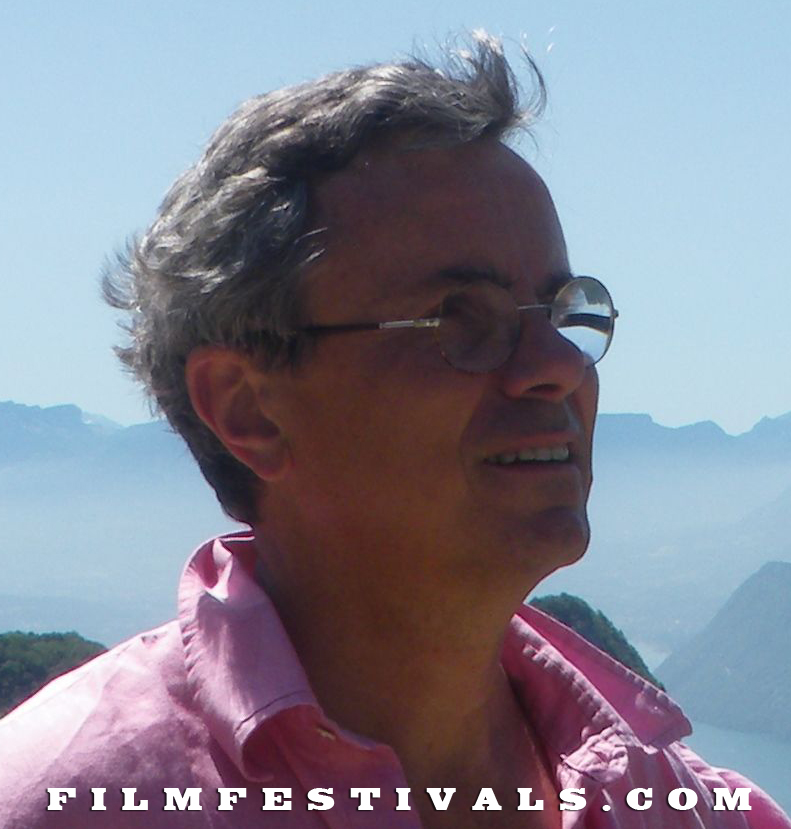
Li Yang puts Blind Faith in Human Nature
Li Yang's debut feature Blind Shaft was obviously one of the revelations
of the latest Berlin Film Festival. In this film about a murderous duo in the
illegal coal mines of Northern China, Li Yang set a harsh and humorous tone
which struck a chord both with the audience and the jury, since the director
got Best Sceenplay on Awards night. Li Yang tells us all about his true "underground"
film and the fast-changing landscape of his home country.
Could you tell us how the acting background of your family and also how
the Cultural Revolution had an impact on your younger days?
My family are all from an acting background, famous actors of theatre and TV.
My mother was an actress too. Because my father who was a very famous actor,
he was a political prisoner for many years during the Cultural Revolution. So
my childhood was rather desperate, with a lot of problems. Because, as you know,
a family with a political prisoner will face all kinds of problems.
My mother had to earn all the money when my father was in prison. There was
a very strong motivation for me to support my father after all his problems
and show his movies. I liked to watch movies all the time when I was young,
and also theatre. So I was very much influenced by my family background. It
was a brutal change from a well-to-do, respected family to a family with a political
prisoner. If your parents are put in jail for political reasons, nobody cares
for you. So I know what it means, from the depths of my heart, to be poor. That
was also a very big influence on my life.
Why did you decide to go to Europe?
There are two reasons to this departure. One is that, from a very early age,
I was very interested in European culture, I read many French and German novels.
So European culture always exerted a very strong influence on me. Another reason
is personal. My girlfriend, at that time, went to Germany, so I was very motivated
to join her! (Laughs)
How did you look at China once you were in Europe?
I felt sort of detached from China, both in a geographical and emotional sense.
I was able to look at China from a much more objective kind of perspective.
What went on in China, the changes that took place here. I was more cold-blooded
and detached.
How did you find the issue of Blind Shaft?
The basic story was in a newspaper. It caught my attention. And then it happened
that an acquaintance of mine, who was a writer, transformed this newspaper clipping
into a mid-length novel. So I was even more interested. I called him up and
asked him if I could get together with him and make this the basic story of
my movie. I felt somebody should take the responsibility to portray this kind
of life.
What kind of research did you do?
First of all, I checked all the reports I could get and checked the material.
Then I felt that in order to get a picture of reality, there was no other way
than to go there. So for one year, I travelled around the coal mines, mainly
in the northern part of China. I lived with the coal miners, I took part in
their experiences, I talked to them. So this movie is really based on self-experience,
facts and stories.
You seem to have had a lot of difficulties shooting the film.
Making this movie was a very, very tough experience. First, it was physically
dangerous. The whole of the movie was shot in real shafts. We were down in the
shafts, several hundred meters deep. Some people told me: " It's like going
down to hell ". And, of course, there is always the danger of gas explosions,
of the shafts crushing people and imploding. So it was very dangerous. We didn't
know if we would make it through to the next day. And, also, some people were
indeed reluctant to do this. I had to persuade them to go down into the shafts.
And after we had shot half of the movie, the crew just went away. Actors didn't
want to go on. We had to get them all back together and get the set going again.
Furthermore, since it's a real "underground" movie, so to speak, there
were also all kinds of problems, like financial problems, political problems.
So, in my experience, it was really a hard movie, and we never knew whether
we could finish it at all, so I was very glad that I was able to really finish
it.
Could you elaborate on the problems you had with the authorities?
Of course, I ran into problems with the film censorship. But also, a lot of
the mine owners didn't want to cooperate with us, because there are many illegal
mines. But I have to say that, on the other hand, there were a lot of people
supporting me and the idea of this movie. There were some government officials,
friends - of course, I cannot go into details here. All of them secretly told
me: "It's a really good thing that you portray our life here." Because
they found that I didn't have any evil motivation in doing it, by exposing them
or criticizing them. My idea was just to really portray, very carefully and
realistically, their lives, so they said: "Somebody has to do this."
So they accepted that it was my responsibility, otherwise I could never have
finished this movie. Without their support and help, I would never have been
able to make it.
You also portrayed life in the mines with humour.
It was a key point when I was writing the script. Because when I lived with
the miners, I found out that these people are really humorous. It's not something
inserted into the script to make it more vivid or livelier. It is just that
the Chinese, apart from having very harsh circumstances of life, have always
kept this kind of optimism, and this strong idea that there will be a better
tomorrow. They are optimistic, happy, and humorous. It was very important for
me to portray this because, really, it's part of their lives. There's joy and
sorrow very close together. I think in a way, it's very Chinese, this optimism
for a better tomorrow even if you are challenging the greatest problems and
hardships.
One of the funniest moments of the film comes with the karaoke parody of the
socialist anthem…
This karaoke scene deals with an old revolutionary song that is part of our
life. Now people are experiencing materialism and capitalism in China, after
having experienced reform, and they feel they have lost something. There is
the same feeeling in many countries that had socialism before. Even in Eastern
Germany, you can find feelings like this. So they feel lost in this new world
and they look for something to cling onto, remembrances of their childhood.
The parody of the song, I didn't make this up, it's real. And it's not the only
one, they are flourishing. And it's one way for us, Chinese, to deal with political
things, it's a more humorous way of expressing our feelings in a more subtle,
indirect way.
Could you now talk about the two main characters of the story, those partners
in crime?
The basic story is true. It happens in some parts of China. Two people plot
together, or some are doing it on their own. What happens also very often is
self-mutilation: people will cut off an arm, a leg or a foot in order to get
compensation claims. That's a big problem. For me, it was important to show
those two people who turn into partners in crime, against this whole picture
of society, what is happening there. Of course, these people are not bad by
nature; they just become this way, to achieve something. Obviously, I don't
like this kind of human beings. I think human beings should be benevolent. But
I wanted to show that they might turn for the better.
How do you feel about the late evolutions and the surge of capitalism in Chinese
society?
China is now in a process of constant change. I think, first of all, it's a
very good change. I think society should change. It's more useful than dreaming
about what is lost, about the past. Of course, in this process of change, people
will now pursue the God of material wealth. But the important question that
the Chinese have to ask themselves now is: " Can money replace moral beliefs,
ethics? " Now that we can make money, get richer or less poor, what are
we going to do about this? Because I think that a money-driven society will
be a very cold and harsh society. And when people band together to kill others
just to get material gains, it's a very awful thing. I think human beings should
try to live just like human beings and not like animals, trying to kill each
other to feed on each other. So I still wonder how we are going to live in this
future society and whether our beliefs will enable us to live together like
human beings should.
Robin Gatto & Yannis Polinacci


