Mumbai International Film Festival launches its 19th edition, MIFF 2026
Mumbai International Film Festival launches its 19th edition, MIFF 2026
Now under the wings of the National Film Development Corporation (NFDC), the 19th Mumbai International Film Festival (MIFF) is being held from 16 June to 21 June. It was inaugurated on 15 June, at the Ravindra Natya Mandir, in Central Mumbai, but the main venue is the complex hitherto known as Films Division, on Peddar Road (Dr. Goplarao Deshmukh Marg), South Mumbai. This time, the festival has on board the Maharashtra Government, as co-organiser. The local state government owns and operates Ravindra Natya Mandir. There was a pre-festival, curtain-raiser press conference on 13 June, but I was not invited, although I had already been approved as a media-person, attending MIFF, two days earlier. Accreditation cards were being distributed at the National Film Development Corporation (NFDC) complex, which acquired FD in March 2022, and it would require an extra trip to that place, to collect it, besides coming back to attend the inauguration, some 6 kms away. I assumed that good common sense would prevail, and that both cards, the accreditation card and the invitation card for the inaugural ceremony, would be available at Ravindra Natya Mandir. Journalists could reach earlier than the scheduled opening time of 5 pm, and collect both cards. No such luck. Only passes for the inauguration were given out there. One would get the accreditation card only when one went to NFDC, the next day, or later, which I did, on 16 June. But before I get to MIFF 2026, here is some background to the festival.
Back in 1990, a film festival dedicated to documentary films was unheard of. But the Ministry of Information and broadcasting, Government of India, went ahead and held one, in Bombay, as it was then known. Organising the festival was a task assigned to the Films Division (FD), a wing of the Ministry, which made documentaries, and, earlier, newsreels. They had 2 or 3 small auditoria, which would accommodate the sparse crowd that was expected to be interested in such an event. Later, it moved to other, much bigger venues, like the National Centre for the Performing Arts and the Nehru Centre, Worli, central Mumbai, within which the earlier offices of NFDC were located. In recent years, the FD complex added 2 more auditoria to its buildings and it also houses the National Museum of Indian Cinema, which has 2 auditoria of its own. This was quite sufficient to seat the turnout, but outside venues were still used, like the House of Soviet (later Russian) Culture, which is situated just across the road.
After the newsreels, screened every week before feature films, mandatorily, were discontinued, in the 1990s, due to the growing influence of television, and cinema owners challenging the statutory screenings, FD lost its raison d’ȇtre. Its documentaries were of inconsistent quality, though some of them were outstanding. Even when the documentary/newsreel screenings were mandatory, the cinemas were given a choice, between screening a short newsreel or showing an FD documentary, of up to 20 minutes, and most preferred the newsreels. This was partly because the newsreels were shorter, and they often had clips of cricket matches where India was playing. In the absence of TV coverage, radio commentaries were the only way audiences could be up-to-date with cricket matches. In the pre-video era, and it was only in FD newsreels that they could see their favourite stars in action. During the screenings of documentaries, many cinemagoers would go out for a smoke. Many more people were addicted to smoking in the pre 90s era than now. Cancer was not considered such a big threat then, and there were no warning slides or films shown before the feature film.
In this scenario, the decision to hold an international film festival for documentary and short fiction films, under the aegis of FD, was expected to give a fillip to the dwindling production 0f, and minimal exposure to, such films. The venue would be Bombay, and it would be called the Bombay International Film Festival (BIFF). For the first two festivals, this writer had the honour to serve on the Selection Committee, which had such luminaries as Prof. Satish Bahadur, who used to teach film appreciation at the Film and Television Institute of India, Pune, and Vijaya Mulay, a renowned documentary filmmaker, based in Delhi, who was popularly addressed as Akka (older sister). Of course, I covered the festival as a journalist too.
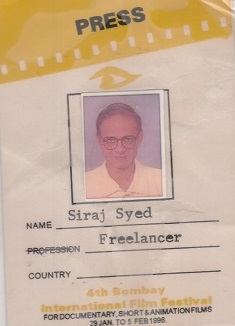
I do not recall who of the two had recommended my name, but there I was, watching film after film, for 7-8 hours a day, for a token honorarium, to select the best of the lot. Quite a few entries came from other countries. The festival also had a competition section, though the prize money was by no means generous. There were some 5-6 other members in the selection Committee, whose names I do not recall. The previews were held in FD’s own mini auditorium. Watching so many documentaries and short fiction films, one after another, taking a very short break in between, to make notes, was an experience alien to all of us. But the love for good cinema overcame the tedium.
Both Vijaya Mulay and Satish Bahadur are no more. But I have very fond memories of both of them. Akka, a loving, caring personality, was the oldest member of the panel. She passed away a few years ago, when she was well into her 90s. Readers might relate to her through her daughter, Suhasisni Mulay, a well-known actress. Satish Bahadur had taken a liking to me, when I attended the Film Appreciation Course, jointly organised by the National Film Archive of India (NFAI), headed by late P.K. Nair, and the Film and Television Institute of India (FTII). Our ‘friendship’, if I may call it so, since he was much older than me, grew over the years, and I often visited his house in Pune, whenever I was in that city.
Since I was, and am, a film-critic, the 5-week course had enhanced my knowledge of cinema to a great degree. So much so that I used to take a few days off from my Bombay commitments and attend subsequent batches of the Film Appreciation course, which was an annual event. I would attend it only for 3-4 days, as my work in Bombay would not allow me more time. Although I was not an enrolled participant, Prof. Bahadur (Satish Bahadur was part of his first name, Bahadur not being his not his surname; nobody knew his full name) was kind enough to allow me to make a ‘special appearance’, for 3-4 days. I used to stay at the FTII hostel, where rooms were available in plenty, because most of the regular students, who had rooms there, would go home during the June holidays, when the course was conducted.
BIFF was a biennial event. You might wonder why was it so, as I did. The reply I got from the organisers was that it would be difficult to get good documentary and short films every year, and the budget allotted for hosting it, which came from the Ministry, was not enough to hold a festival every year. I strongly felt that these hurdles and make it an annual fixture, like the International Film Festival of India (IFFI). I went to the extent of putting this proposal to the then Minister for Information and Broadcasting, and was assured that it will be considered. I was also told that the suggestion was likely to be accepted. However, BIFF continued to be a biennial event. The only change was in nomenclature: BIFF became MIFF, because Bombay became Mumbai. And, oh yes, FD films could now be screened on Doordarshan, the government owned TV channel, which was the only TV channel allowed to function in the country, till 1992-93. Also, the festival was expanded a few years later, to include a separate category of animation films, besides documentaries and short fiction films.
After attending the 1996 edition, I had to miss a few, as I had relocated to Singapore, to set-up ESPN’s Hindi sports channel, and returned to Mumbai only in 2004. In the years between 1998 and 2004, I must have attended at least one MIFF, taking my annual lave from my job in Singapore to coincide with the dates of MIFF. Since 12004, I have not missed any MIFF. Not only that, I wrote extensively about the festival and the films screened, in various newspapers, and from the 2010s, on websites. After its merger/acquisition/absorption by the NFDC, the festival was organised by the NFDC in 2024 and will continue to be organised by them. A few members of the FD staff were absorbed into NFDC.
Coming to venues, the regular Audi 1 and Audi 2 of the NMIC, and the RRIII and Jehangir Bhownagery halls of the theatres of the FD could be called the main venues. Within the complex, we now also have the IICT hall. IICT is the latest member of the unit force of the Ministry of Information and Broadcasting. The National Centre of Excellence (NCoE) for AVGC-XR has been operationalised as the Indian Institute of Creative Technologies (IICT). It is the premier institution for creative technologies, located in Mumbai. IICT is being developed with a total allocation of ₹391.15 crore and is modelled on the lines of IITs and IIMs for the creative technologies (including AVGC-XR). It has started operating from the NFDC campus in Mumbai, since December 2025.
It follows an industry-oriented curriculum aligned with global best practices and functions on a Public–Private Partnership (PPP) model as the national hub under a hub-and-spoke framework. IICT is addressing the skill gaps in Virtual Reality, Augmented Reality and 3D modelling through specialised training programmes, industry aligned curricula and applied Research and Development. The institute has launched 17 specialised academic programmes across gaming, post-production, animation, comics and XR. It is located in the Phase II building of the NFDC campus, on the 4h Floor. There are other venues too: Ravindra Natya Mandir (some shows) and the Usha Pravin Gandhi institute of the Shri Vile Parle Kelavni Mandal (SVKM)+St. Paul’s. St. Pauls is located in Bandra while Usha Pravin is in Vile Parle. I do not know whether the two have a joint campus somewhere, because the films listed for screening at this/these venues have the same schedule. In terms of dates, MIFF has shifted back and forth, from January to March. I think this is the first time it is being held in June.
So, here I am, on the afternoon of the 16th of June, 2026 (I had to attend a court hearing at 3 pm, so I could not go earlier), entering the precincts of the erstwhile FD, now absorbed by NFDC, and heading for the Media Desk, to collect my accreditation card.