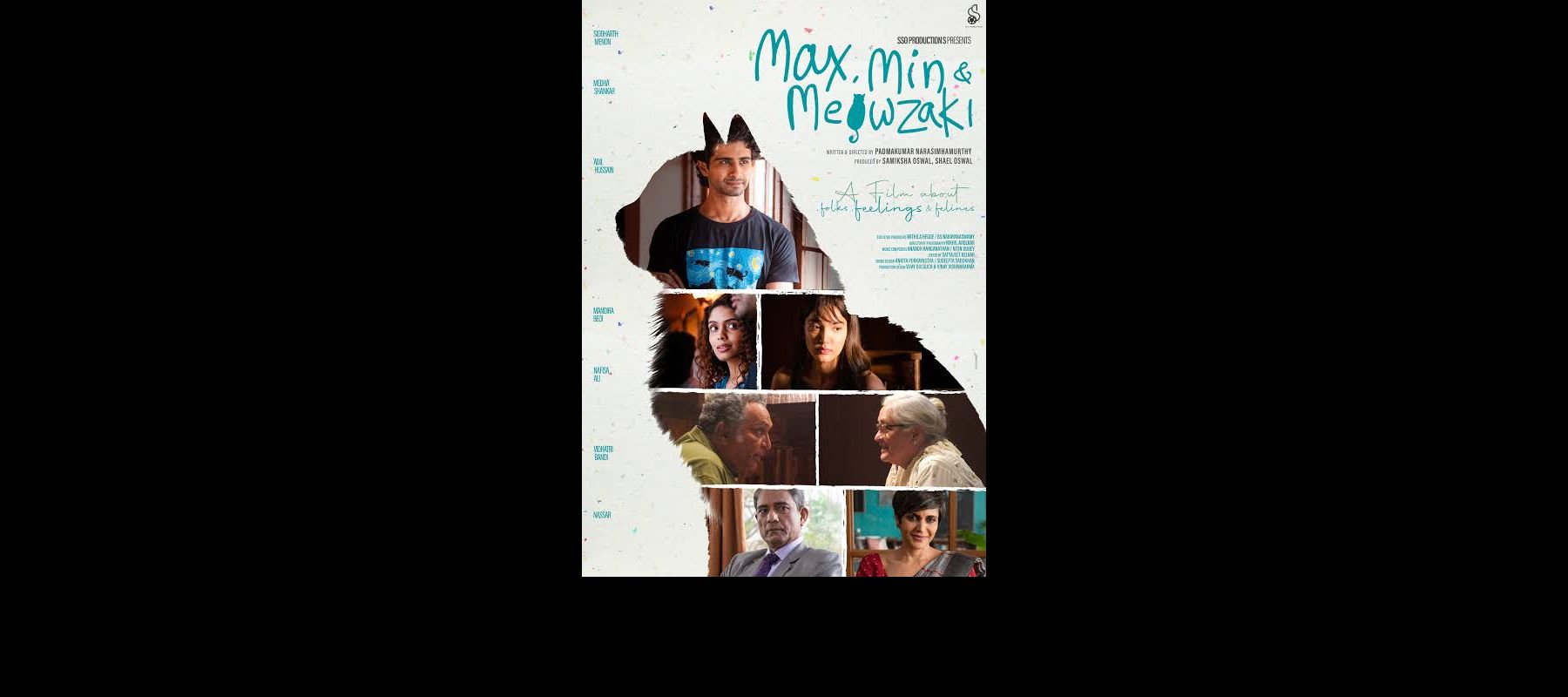
Max, Min & Meowzaki, Review: Cats, Crying and Conflict
Max, Min & Meowzaki, Review: Cats, Crying and Conflict
What are the chances that you will understand what the title means? 50%. Max is obviously a name, usually an abbreviation of Maxim or Maximillian. Min? You don’t know what it ‘min’s! Meowzaki? Well, you will get the first half of this two-part word: Meow means that there must be a cat (or Cats) in the movie). Zaki? Zaki is a Muslim name, but I bet you do not know that it means intelligent, smart or virtuous. On seeing the film, you will discover that Max is a name, but it is not short for Maxim or Maximillian. It is a character called Mahesh, who prefers to be so addressed. ‘Min’ could be a mini abbreviation of ‘Mini’, of Minister, but it turns out that it stands for Minara. There is a Minara Masjid in Mumbai, so is there a Muslim connection? Bull’s eye. Minar and Minara(h) mean a tower, minaret, spire, or turret. But our heroine is never addressed as Minara in the film, just Min. Meow is the sounds cats are supposed to make, isn’t it? And let me also tell you that Zaki is definitely not the name of a Muslim player in the film. It is 1/3rd of the name of Japanese animation film-maker, Hayao MiyaZaki. Mahesh, Minara, cats and Miyazaki…that’s quite a fine/different kettle of fish, as a film’s name. Is it attractive? Do triple ‘m’s (MMM) spell success, in numerology or onomatalogy? Now I am complicating things! What is onomatology? Could be a KBC question! It is the science of the study of names. While you are at it, please also look-up for the meaning and significance of the name Padmakumar Narasimhamurthy (PN), for this is the man who wrote and directed Max, Min & Meowzaki.
A giveaway. PN is a great fan of Miyazaki, and of the Japanese language. The couple in the lead roles are brought together by Max’s love for Miyazaki’s films, which rubs off on Min. They watch Miyazaki’s films together, and fall in love, together. Together? The film begins with their break-up. Min is the initiator of this break-up. Max starts an inventory of their live-in pad, and generously, or angrily, depends on what you know about the couple till then, which is very, very little, he gives most of the paraphernalia to Min. She is moving out, to live with film-maker Arijit Sen, a family man with a teenager daughter. Max will stay on, in the pad, which is Max’s place, in any case. Material belongings can be split and divided, but what will happen to Meow? Meow? They have a cat named Meow? Not really. Its name is Meow-zaki, because that chap Max is mad about the Jap. It is agreed that Max will take care of it, till Min can make some arrangement to take it away. End of story? No! The beginning. The beginning of one track of the film, which moves on several tracks, like the sound tracks that are mixed by the Sound Designer, Editor and Director of a film. This track will rest a while, till the next segment of its path surfaces, but there is another ‘couple’ coming up.
A money-bags called Ramesh Mahadevan has some mental issues. He lost his wife recently, to cancer, and his son, their only child, lives separately, eschewing the opportunity to join his father’s BrahmaTek IT company, which has a worldwide footprint. Instead, the son chooses a career as a singer and voice-over for ad films and jingles. Ramesh finds this outrageous and it bothers him a lot. So, he decides to see a psychiatrist/counsellor, named Dhara. A rich businessman like him would have thoroughly checked the credentials of the counsellor he is going to visit, but, in the film, the introductions happen across the table. Weird! Dhara puts him at ease from the minute he enters her consulting room, and he slowly, stutteringly, hesitantly and falteringly, opens up about his strained relations and conflicts with his family. He is the son of a legendary Carnatic music singer, who now lives in an old folks’ home. Since he did not inherit his father’s musical genes, there is a schism between the two of them. Moreover, his father, Sridhar Mahadevan, who was on tour most of his life, showered his affection on his daughter-in-law, and not his son. To add to his woes, his son is having an affair with a girl from a different religion. After his first psy session, as he gets up to leave, he is hit by severe back pain, and almost falls over. Dhara helps him lie down, and performs reiki on him. Ramesh is impressed, and, though he had earlier decided not to visit her again, he becomes her regular ‘patient’. Time for the third couple.
Sridhar, who is paralytic, lives in an old folks’ home, and moves about on a wheel-chair. For company, he has Jennifer Sequeira, another inmate. Jennifer’s daughter and son-in-law died years ago, in a car accident. Now, her grand-daughter Carol lives alone, and is a ‘cat-sitter’ by profession. Grandpa and Grandma hit it off like a house on fire. She has median level Alzheimer’s. Sridhar, who is paralytic, has a swig every Sunday, and Jennifer gives him company. She also makes sure that he does not get into activities that a person in his condition should not, like playing games, in the field outside, with children. This is pure, platonic love, between two persons of different faiths, who live independently, away from their children and grand-children, and find peace and happiness in the company of each other. Now don’t tell me there is another couple coming up! Can’t help it. There is. But I will not spill any more beans, and my narration of the story gets into a frozen frame here.
While one admires Padmakumar Narasimhamurthy (PN) for making a film that has no fights or villains, decapitation or high octane action, one feels that he is biting off much more than he can chew. Meowzaki is not the focus of the film, though it plays the role of a catalyst, by doing pretty much nothing. Max’s character gropes around to find his moorings, grows long hair to sing at gigs, and has ambivalent values about pre-marital sex, but wants to keep his pre-marital baby, that is growing in Min’s womb. After the split, he explores the App, Tender (not a typo; PN makes sure that he does not infringe upon the copyright of any product or service, avoiding real names and using ‘similar’ names for a host of things), but gets put off when his date wants to lead him into her bed. Min is the most poorly written character. She mopes and cries for 90% of her screen-time, aborts the baby that Max wanted, breaks-up with him and goes to live with a married man and his family, comes back for the cat, and cries again. There is no attempt to redeem her doings. So much for Max, Min and Meowzaki.

Other characters are fleshed out much better. Ramesh accepts that he has treated his father, wife and son badly, and wants to make amends. His therapy sessions with Dhara are quite realistic, including his mis-pronunciation of Dhara as Dara, being a Tamil speaking Brahmin from Chennai, as is his awkwardness in answering her questions. His admission that he lied to her earlier comes not as an apology, but more as a confessional statement, which quite in keeping with his character. But the Hindustani he speaks is near-perfect, with only a few potholes written-in, wherein he can actually admit that his Hindi is not so good. This is unrealistic. Moreover, you wonder why did PN cast Adil Hussain, an Assamese actor who lives in Delhi, as the Tamil Brahmin, Ramesh Mahadevan? One reason could be that he has known Adil for over a decade and admires his acting abilities. Who doesn’t? He is a scene-stealer, who blends seamlessly with any scene/situation.
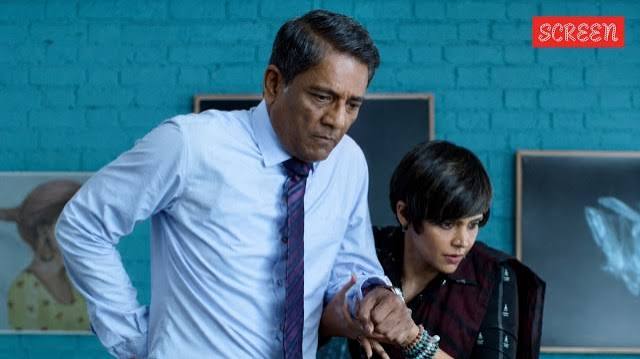
Dhara is depicted as a highly qualified and competent counsellor, and leads Ramesh to the path she wants him to tread, without ever making him realise that this is therapy. Having inter-acted with many psychiatrists and counsellors, I can say that there are extremely few who will be able to treat cases like Ramesh with the skill that Dhara does. Moreover, such practitioners always have a staff or assistants around, while Dhara sits alone in her consultation room-cum-home. I think PN has created a near perfect ‘doctor’, which is bit hard to digest.
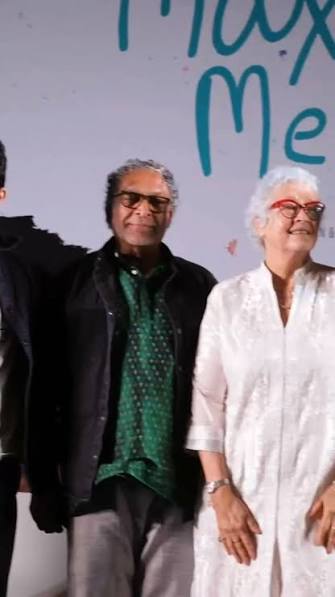
Nasser, from down South, who can play anyone, from arch villains to comedians, is a piece of befitting casting, as Sridhar Mahadevan. Coming into the story late in the day, his character endears himself to the viewers from the word go. His part gets its due footage as the plot develops, and the scene where, in the Home, unknown to him, his son is listening to him, talking about his family, is shared by two great actors, with more sympathy swinging the way of the ‘cold’ son, as the warmth and regret wells up in his conscience, and it shows. One twist in Sridhar’s tale is unpredictable, but, unfortunately, the last one is visible on the horizon much earlier than it happens. Kolkata-born Nafisa Ali is quite a legend, in fields other than cinema. Daughter of Ahmed Ali, a Bengali, and Philomena Torresan (was she from the Torres region of Italy?), a woman of Anglo-Indian heritage, Nafisa is a politician, social activist, and former beauty queen. She had given up acting many years ago, to raise her children, but PN brought her back from hibernation, and to prime focus. And there is a bit of irony in her tale. Playing grandmother Jennifer Sequeira, with Alzheimer’s, in MMM, she was, in real life, diagnosed with stage 3 peritoneal and ovarian cancer, in 2018. Even as this film is released, she has she has been diagnosed with stage 4 cancer, entering her third remission this very month. One knew about her Bengali ancestry, but the Anglo-Indian angle must have prompted PN to cast her as Jennifer. Her chosen isolation, from her loving grand-daughter, seems a little unrealistic, in spite of her ailment, and her desire not to be a burden on Carol. A prayer for her recovery.
If PN is not a cat lover, then the producer is. That is on record. So, he makes Min a cat lover, Carol a cat-sitter, with many a cat, of various paws and meows, and Max, who overcomes his allergy to cat fur, to metamorphose into a cat lover. Is PN a dog lover too? Maybe. He weaves in a scene in which a woman, who is a dog person, gives Max some advice on his allergy problem. Producer Shael Oswal has 100 dogs, in real life. So, PN is a cat lover, and a a dog lover and a …Miyazaki FAN!
And being a fan of Miyazaki, he has both Max and Min speak Japanese at least ten times in the movie. No, not just the odd word or phrase, Like Ohaio gosaimas or Kon ichiva or Kon banva or Oyasu minasai (Google, will you? Please) …entire sentences. Wait, I’ll count… ichi, ni, san, yon, go, roku, shichi, hachi, kyuu… juu…that makes it ten times. (Showing off my Nihongo—Japanese—am I? Well, to be honest, Watashiva Nihongo skoshi wakaru kara. (Since you are already on Google or Gemini or Chat GPT or Claude, look up this sentence too). You liked it? Arigato, which is, I might as well tell you, “thank you”.
PN is also concerned with the religious discrimination that is assuming alarming proportions in our country. He makes his point, without hurling it in your face. Minara is a Muslim, and Max’s father disapproves of the inter-religious liaison, because, “Being a Mahadevan is a great advantage in these times.” Wait a minute. Dhara is also a Muslim. Her real name is Inzia, but she assumes the name of Dhara, to conceal her faith. Haven’t heard of doctors having to do so, but you never know. PN is also concerned about lesbianism being a taboo, so he makes Dhara and Yuki (her live in partner, enacted by co-producer Sameksha Oswal, in a cameo) lesbians.
As seen above, his casting, in this ensemble, is secular in a strange kind of way. An Assamese actor plays a Tamilian. Siddharth Menon (the surname reveals all) is a fair-skinned Tamilian (though his father is dark), who speaks good Hindustani, English and Japanese, is cast as Max. You read about Nafisa Ali. Mandira Bedi, though Kolkata-born, is a Sardarni. She is both Inzia (Muslim) and Dhaara (Hindu). Her bed-mate is named Yuki, a deaf and dumb woman, who is a very good painter. Yuki is a Japanese name, but PN does not develop her character enough for us to know her roots.
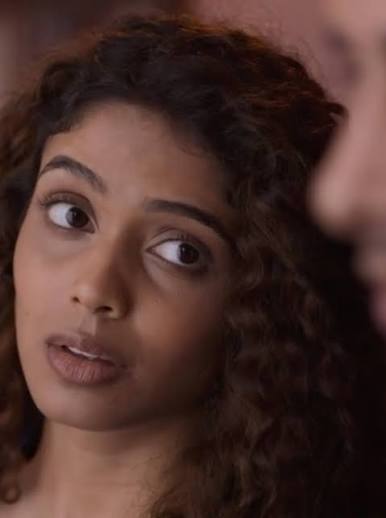
Info is low on Vidhatri Bandi, aka Carol (I just love this surname, as any banda would), who did Jalsa, with John Abraham, for Amazon Prime, playing a Malayali journalist. A UCLA 2016 graduate, she got a couple of good roles early in her career, went through a hiatus during 2022-24 (MMM was completed in 2022, went through the festival circuit over the last four years and finally released in July 2026), is inspired by “legends like Savitri Garu and Sridevi ma’am”, and “it would be a dream to have a career trajectory like theirs. My dream role would be playing a classical dancer.” Well, a cat-sitter is nowhere close to a classical dancer, but the confidence oozes all through her scenes. Quite a cool cat, Vidhatri! Her co-actor in the film is Medha Shankar, the NOIDA girl, who is a trained classical singer. In MMM, she plays a confused cry-baby. From the cast, the lead romantic pair, Siddharth Menon and Medha Shankar, have the least defined roles, which is odd indeed. Look out for Canadian actress Elisha Mayor, who plays Max’s Tender date, and asks him upfront, “Do you like it hairy, or shaven?” Somehow, all the dialogue seems to come pat, as in a stage play. There is very little thinking or contemplation before most of the characters speak, or reply., even if the reply is unclear. Too many rehearsals?
Made with competent behind-the-screen contributions from the team of music composers Nitin Dubey and Anandh Ranganathan (the sound track has a generous dose of background music), Cinematographer Nikhil Arolkar and Editor Satyajeet Kelkar, Max, Min & Meowzaki had great possibilities, but failed to tap some of them, by chasing too many plot points and criss-crossing tracks, including the running of Miyazaki’s film in an Indian theatre, a piece of wishful thinking. After an OTT outing, this is PN's first feature cinema release. It ends on a familiar heart-warming and eye-moistening note. Yet, it is one of the better films seen this year, and worth watching. PN can only grow from here.
Wonder whether 85-year-old Hayao Miyazaki, the acclaimed manga artist and animation film-maker, has seen the film, and if so, what did he feel about it. Miyazaki won his second Academy Award for Best Animated Feature, The Boy and the Heron (2016) at the 96th Academy Awards, becoming the oldest director to do so.
Kakuduke/Rating: ***