

Kimidin, Review: Kill Inveigle Mangle Infiltrate Devil Investigate Neutralise

Kimidin, Review: Kill Inveigle Mangle Infiltrate Devil Investigate Neutralise
Kill 21 innocent persons, including 16 women.
Inveigle a police officer and force him to commit suicide.
Mangle victims’ bodies and eat their body parts.
Infiltrate an ordinary grocer’s body and mind, and turn him into a killing machine.
Devil in the garb of a normal human being, spreading his philosophy of total anarchy and evil incarnate.
Investigate baffling serial killings, unconnected and without a motive, all by the same man, who claims that he is unaware of having committed any of them.
Neutralise all social, religious and mortal institutions, repeal all laws, let terror and cruelty rule.
No, Kimidin is not an acronym. According to AI, Kimidin refers to a class of evil, flesh-eating spirits or demons, often linked with disease-causing organisms, described in ancient Vedic literature, attributed to Atharvaved. However, Kimidin, the film, begins with an ancient looking scroll, which unfolds automatically, and on which is written as quote from Rigved, in Devnagari script (the film was made in the Marathi language), which, unfortunately, flashes past before you can read it, but the last word is ‘kimidine’. But it matters little to the viewer which Ved is the source of the subject (maybe it finds mention in both the Veds) of this film. Kimidin, launched in March 2024, was screened at the Third Eye Asian Film Festival (TEAFF), last month, where I missed it. However, I got to see it a mere two weeks after TEAFF was over, thanks to the good offices of Navalakha.
Nothing will prepare you for the unfolding mythological thriller on the screen, crafted by the man who produced films like Shala, Anumati, and Fandry, Nilesh Navalakha, marking his debut at wielding the megaphone. Kimidin is as different from the above films, produced by Navalakha, as chalk is from cheese, fire is from ice, night is from day, and north is from south. It is probably the only film which has the maximum amount of recurring, vivid and explicit descriptions of gut-wrenching, gory murders and cannibalism, all oral, without a single shot of the killings and the abhorrent feasting on the victim’s flesh.
A psycho-mytho-(il)logical thriller, Kimidin has a deceptively simple and realistic packaging. In a during credits scene, we see a police officer in uniform, entering a room, looking dazed and fazed, taking off his cap, sitting down on a bed and leafing through a file. Suddenly, his face shows horror. He pulls out his gun and aims it at his temple, even as the opening credit titles are over. Changing his mind, he decides to bite the bullet. In other words, he shoots himself in the mouth. The police officer, Saxena, was investigating a case in the city of Pune, which has been plagued with a series of killings, dismemberment and cannibalism, with as many as 21 victims, in a matter of a few weeks. A man has been arrested at the scene of the last crime, caught red-handed, and is in jail. The Police Commissioner assigns the case to a Deputy Commissioner of Police (DCP), Dhananjay Dharmadhikari, who is described as an “honest cop”, by the media.
Dharmadhikari heads straight for the lock-up where the accused is kept, and starts interrogating the man, Manohar Mahajan. All of the interrogation is recorded in an adjacent room. When questioned about the murder, Manohar, who is in acute pain, denies the charge, and even denies having ever visited the scene of the murder, where he was arrested. He says he runs a small grocery shop, and is wondering why he has been arrested and brutally beaten by the previous interrogator. While the interrogation continues, there is a media outcry for bringing the dastard to book, and the Police Commissioner pressurises Dharmadhikari to gather evidence and put Mahajan on trial, asap. There is plenty of evidence available. His finger-prints, his teeth marks on the bodies of the victims whose flesh he has eaten, and more, but that is all circumstantial. In view of the absence of a clear motive or intention, the police feel that Mahajan will take advantage of this loophole in the Indian Evidence Act, and go scot-free.
As he is leaving the lock-up, after a long interrogation session, Dhananjay hears a stentorian voice, asking him not to leave, a voice that could not be Mahajan’s. As he turns around, he sees that the normally brooding Mahajan is in a state of animation, and introduces himself as Kimidin, the faceless demon of the Vedic era. In an animated flashback, we see the gods battling the horrendous looking Kimidin. The voice-over tells us that after collectively pitching in all their might, the gods could only capture Kimidin, not eliminate him. As and when the power of the gods gets weakened, Kimidin escapes, to wreak havoc on earth.
Dharmadhikari dismisses the outburst and tells Mahajan that he will not be fooled by this impersonation, or schizophrenic attempt, by Mahajan, employed to plead insanity as a defence against the charges, because Mahajan has already been examined by three eminent psychiatrists, and found to be perfectly normal. But when Kimidin reveals confidential details of the Saxena suicide, facts about his (Dharmadhikari’s) own life that nobody was privy to, and claims that he manipulated the handing over of the case to Dharmadhikari, he gets the goose-bumps, and continues the interrogation, which has now become a conversation, with Kimidin/Mahajan, who informs him that he has possessed the body and mind of Mahajan, and it was he who was responsible for the killings!
Though quite gripping for most of the way, the screenplay of this psychological-cum-mythological thriller, by Sanjay Sonawani (he is also credited with the story and dialogue), and the additional screenplay and direction by Navalakha, have many loopholes.
How is it that the powers of the Gods fluctuate, and allow Kimidin to escape, in their weaker moments? Aren’t Gods more powerful than demons?
Why are they powerless after he escapes, and unable to stop him from running rampage on earth?
Will they ever be able to capture him again? I guess a sequel on the way!
Since when does media describe a police officer assigned to a high-profile case as “honest”? If it does so, it is suggesting, by implication, that the previous officer on the case, or police officers in general, are dishonest! While that may be the bitter truth of Indian society, it is never put in black and white.
Why does Kimidin stop at 21 killings, when he could continue endlessly, with n number of murders, using his power to take control of the minds and bodies of anybody? Let’s wait for the sequel.
If he can manipulate a Police Commissioner into assigning the case to Dharmadhikari, and orchestrate a protest outside parliament, against police inefficiency in his case, he can manipulate just about everything. So, why does he need Dharmadhikari to listen to his perverse ‘philosophy’, and propagate it via a book, in the age of IT? It is too much to believe that a demon’s vision of the world, as might be written and published by an atheist, Dharmadhikari, in the form of a book, at the command of Kimidin, would result in mass killings and total anarchy, and destruction of the world, the ideologies being Kimidin’s mission! The end does give a hint about what could happen next.
If he claims that some of the biggest mass murderers in the past, including Hitler and Stalin, were driven to such heinous crimes while being possessed by Kimidin, why choose a medium level Indian police officer in Pune to trigger a holocaust? He could have possessed the body of a President or Prime Minister, and let loose his philosophy of mayhem. Just because he is an atheist, bribed his way to get a favourable (lucrative) posting, killed a Muslim, suspected of terrorist activities, in cold blood, prompted more by religious fanaticism than a sense of justice, and, though married, is having an affair outside the marriage? These are flimsy reasons for the choice of his messenger.
There are many illogical and irrational occurrences in the climax, but let us keep spoilers out of this review. Since this is a film about the super-naturals, all these occurrences could be attributed to Kimidin’s manipulation!! But, yes, the points that the Indian police is generally perceived as dishonest, and that Muslim suspects are more likely to be the victims in encounter killings than those of the majority community, are well-taken. It needs guts to write and film such scenes, and get the Central Board of Film Certification to allow their retention. Yet, there might be many more such ‘sensitive’ portions that have been deleted under the Censor’s orders.
Casting has played a major role in making the film look like a slice of life. This is to the credit of veteran producer and Johnny-come-lately director Nilesh Navalakha. When Manohar speaks in the voice of Kimidin, there is only a variation of tone and pitch, unlike many foreign and Indian films, which make it sound sinister and creepy. And the laughter, a de rigueur trait of any evil spirit, though loud, is not the crackling, mocking kind, but more derisive and self-congratulatory. To denote the re-entering of Manohar’s body by Kimidin, Navalakha uses jerking of his feet and knees, and a slight body tremor, but sometimes this is just a red herring. Shot more like a play, with the exterior shots added to suit the film medium, Kimidin has drawn some inspiration from the milestone ‘possession’ film, The Exorcist (1973, William Peter Blatty), though there is no exorcism here.
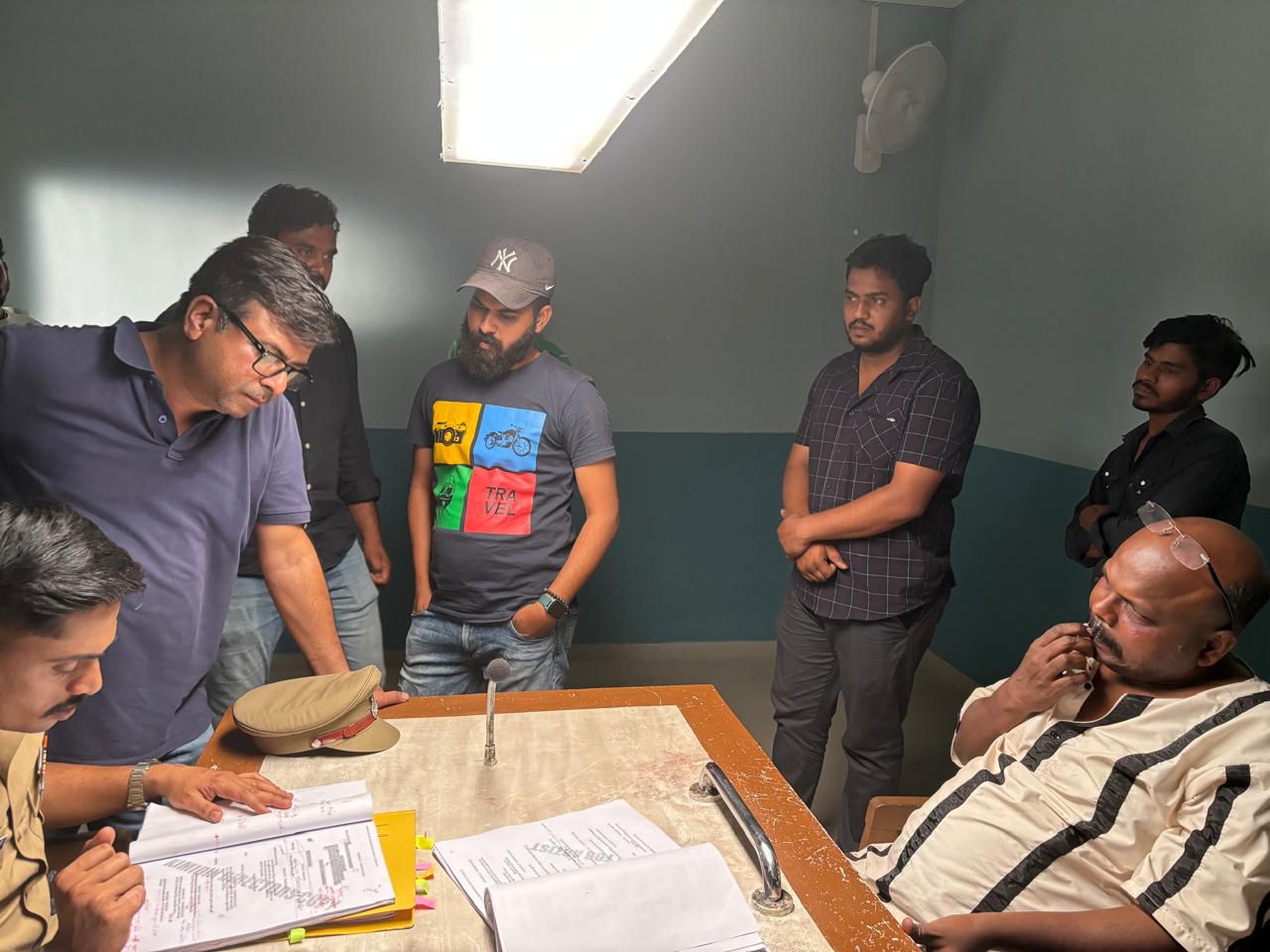
On the sets
Milind Shinde walks away with the acting honours, with thanks, in no small measure, to the script, which gave him ample scope to bring to life the characters of Manohar and Kimidin. Dark-skinned and bald in real-life, he is the dark anti-god here, as also the simpleton grocer. Raj Sane plays Dharmadhikari. Actually, his is the more difficult role. Reputed to be honest, he is cheating on his wife and has bribed his way to get this position. An author and an atheist, he is faced with a demon, who commands him to expand his devilish philosophy and publish it. Naturally, he is confused, perplexed and befuddled, and Sane exudes all these thoughts, feelings and emotions very well. Also in the cast are Manini Durge as Dhananjay’s wife, Rekha, Yashodhan Gadkari as Warden Dighe, Dighe, Jayesh Sanghvi as the Commissioner of Police, Shubham Sudrik (also the creative producer) and Rohan Bagul,
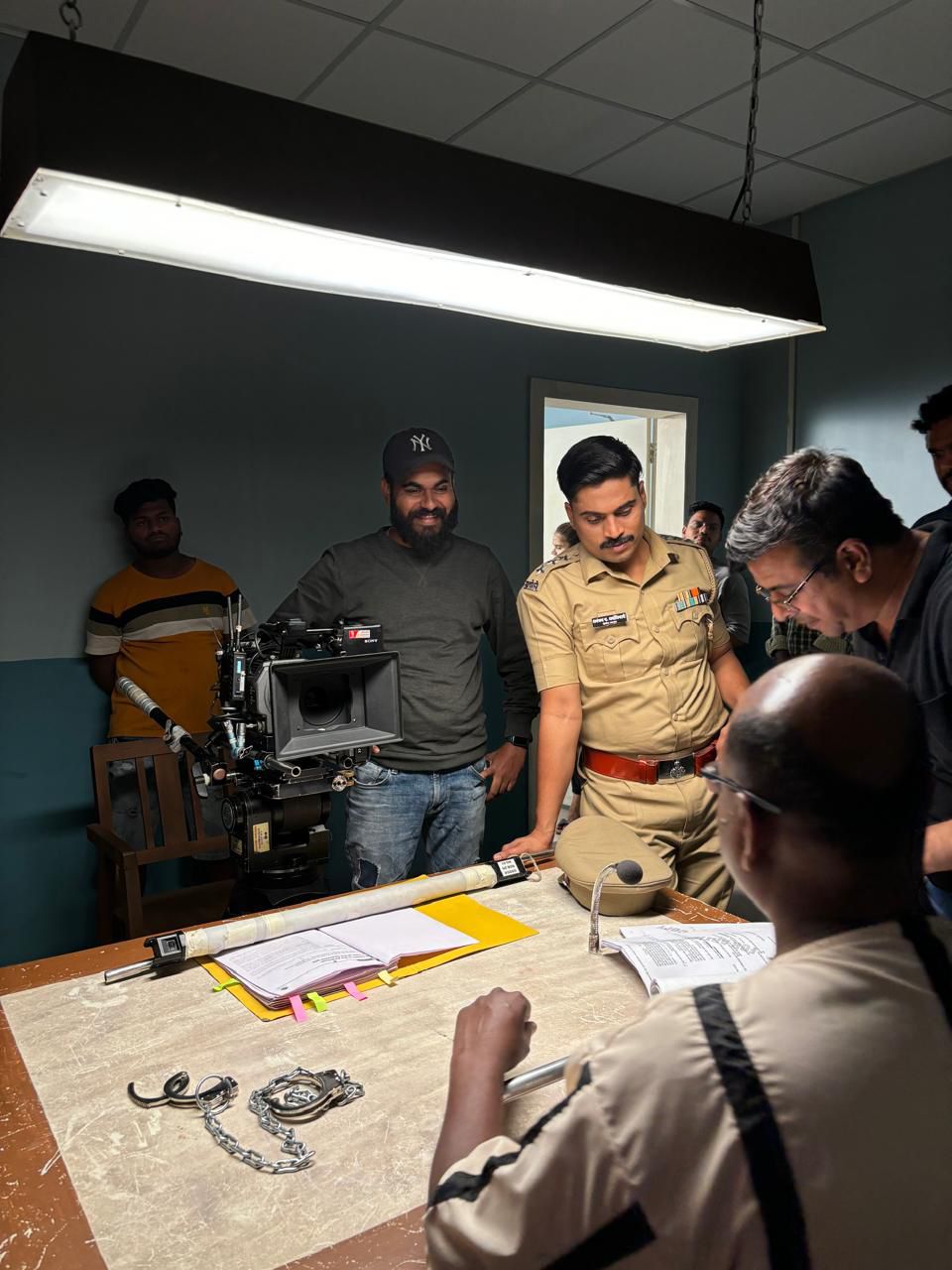
Lasting 109 minutes, the film is well-edited by another Nilesh, Nilesh Rasal. Kimidin uses several circular trolley/dolly shots, a tool used to give the 3-dimensional effect, quite effectively. But sometimes, Pawan Kumar Dhaware’s camera tracks along slowly, showing us the back of Manohar, almost on the full screen, for no particular reason, except, perhaps, continuing the round trolley. Kimidin has been made by a man who does not believe in God or Demons.
Rating: ** ½
Video file


