
Jagran Film Festival, 2026, Mumbai, 08: Review: Nohum, Ho-hum
Jagran Film Festival, 2026, Mumbai, 08: Review: Nohum, Ho-hum
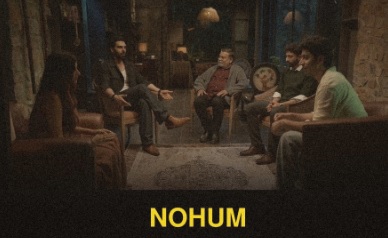
Nohum, according to the writer-director, Shivam Hora, means nothingness, in an ancient language. For the title of his film, he chooses a word that is unfamiliar to about 99.99% of his possible audience, thus alienating most of them. While that might put-off the lay cine-goer, it arouses the curiosity of a critic. If you have not read about the film somewhere, and you walk into a screening of Nohum, unprepared, you expect something new, some kind of experiment, some out-of-the-ordinary subject, hoping to be surprised. Having its world première at the JFF last week, Nohum was certainly was a surprise to me. It is something new, an experimental film and an out-of-the-ordinary subject. The first few minutes command your attention, and you look forward to an exciting psychological, sci-fi thriller. Alas, Nohum flatters to deceive. It wants the audience to go into the writer-director’s mind, and fill in the gaps in the narrative, making their own conclusions. Yes, quite a few films do not have a logical ending, and leave you to guess what happens after the last shot, but this film expects you to start doing your homework just about 20 minutes after the opening scene, and signs off where there would be an interval/intermission in a film with a straight narrative. Nohum is well begun, but, by the end, it is only half done.
A 28-year-old engineer in a New Delhi company, Daksh Beck, logs on, perhaps accidentally, to a site called AA, no, not Alcoholics Anonymous, but Atheists Anonymous. Nursing feelings of atheism, he decides to explore the website and gets the address. Soon, he heads for the place, where he is received by two men, one in his early 60s and another in his early 30s. The man, who opens the iron gate, introduces himself as Shantanu, and the two are later joined by Dr. Pannikar. The two hosts are father and son. Dr. Pannikar is revealed as a retired Indian Space Researh Organisation (ISRO) scientist, now retired. He says he used to make rockets and bombs at ISRO. We also see father and son cooking in the kitchen, as some level of chèfs. Not much is revealed about Shantanu, except that he studied abroad and that he lost his mother three years ago, to cancer.
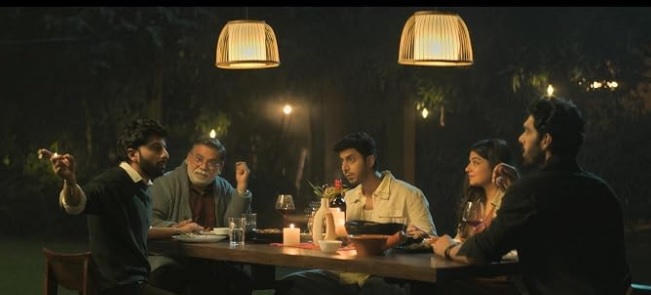
As the three men are getting to know each other and what AA is all about, the bell rings. A couple has arrived, with the same curiosity as Daksh: to find out what AA is all about. They are Abhay and Reeti. All three nurse doubts about the existence of a god. Their doubts are strengthened by the theories of Dr. Pannikar, who says that all three major religions of the world have invented God: Christianity, Islam and Hindusim. To prove his case, he cites the examples of tsunamis and earthquakes, which a God would never want, if he was the creator of mankind. And Hindus have several Gods. Moreover, he adds, that Christianity is based on God having a son and Islam believes that the earth is flat. (This is contradicted by a search with AI that says as follows, “The overwhelming consensus among modern Islamic scholars and traditional authorities is that the Earth is round/spherical. While some early traditionalist scholars held literal views of certain descriptions, prominent classical scholars (such as Ibn Hazm, Al-Ghazali, and Ibn Taymiyya), maintained that the Earth is round, referencing concepts like the rolling of night and day around a globe.
Shantanu brings out a writing pad and asks the guests their addresses, saying this is protocol. By now, the three guests are getting impatient, and ask the hosts about what their views on the subject of Atheism. They say that will answer that, but first all three visitors must sign a contract, that are proceeding with the process their own will. While Daksh and Reeti agree to sign, after some deliberation, Abhay refuses. However, Reeti manages to convince him, and he too signs. We also learn that Daksh is a Christian, and that Reeti is a Muslim, her real name being Uzma. All three are battling trauma, either of guilt or social ostracisation. Dr. Pannikar then tells them about Nohum, the God he invented to fill-in what he calls the vacuum, created by Gods of the popular three religions. Nohum is nothingness, and from this nothingness they have extracted a new God. To become believers in Nohum, the three have to enter another room, and lie down in coffin-shaped, designer pods, with ear-phones in one ear.
This was the stage where the real story, the premise of the plot, should have emerged, strongly. Instead, it gets lost. With state-of-the-art planning and execution, the two AA founders reveal their own God. Atheists inventing a God? Shivam Hora either runs out of steam, or decides that he will rely heavily not only on audiences’ suspension of disbelief, but for them to turn screenplay writers, as well. They are expected to spot fleeting clues and separate them from showcased red-herrings. When asked their addresses, the invitees name areas like NOIDA. That is not an address. No building, no road/street, no flat number is mentioned, but Shantanu does not bother to ask any more. How is it that Daksh, Abhay and Reeti, educated and savvy, come to AA without having done anty Internet search on the two men running AA? Both are named on their website. Bora plays with the timeline too, confusing the audience whether the Tibet episode happened before or after the visits of the three ‘guests’. How were Pannikar and Shantanu able to dig deep into the pasts of the three, and replay an audio recording of the same, into their ear-phones? They had not revealed anything, and had come unannounced. What was the great fireball? How did it appear and disappear? What happened inside the pods, except for hearing a female Goddesses voice through their ear-phone? Did they have to lie down in those glass-top coffins, merely to hear an audio recording?
When Dr. Pannikar terms all existing religions as ‘scams’, and says that he does not believe in any religion, why do the visitors accept the invention of his own religion and his own God? Is it not another, clear, scam, like the religions he condemned? If he could really revive a woman, who has been dead for three years (a scene right out of Alfred Hitchcock’s Psycho, 1960) by preserving her body, and stealing a living woman’s ‘consciousness’, to inject it into the decaying corpse, and bring it to life, so could millions of others. It has to be common knowledge. He has not been chosen as the chief scientist of the world, to carry put this top secret experiment. Why has he been solely gifted? Is he running a secret society? The director told me that Dr. Pannikar and Shantanu were scamsters too. So why and how did the above phenomena occur? Alright, so the duo were scamsters. But where was the electric barbed wire fence and electronic surveillance which, the duo claimed, had been installed to stop the visitors from leaving, after they had signed the contract? If that was a bluff, why was it not really installed?
The scamsters take possession of the visitors’ phones and laptops, but are not worried that they might still be traced if the victims were found missing? With a sign loudly stating Atheists Anonymous, and a large bungalow, with elaborate scientific equipment and gizmos, from where they operate, it would be a cinch to find them and punish them. And why were there exactly three pods in position. AA had no premonition about how many would turn-up. Why does Abhay get into a warped physical form, twisting and turning, unless there is something unreal is happening to him or he is being treated to some electric/electronic waves by the duo? Any man with normal intelligence would smell a rat the moment the proponents of an atheist theory tell him that they have invented a new God. And what’s more, the duo lets two of the three visitors getaway, after a third is subjected to a ‘consciousness’ extraction. Will this not seal their fate? Dr. Pannikar keeps a pistol on a wall-mounting, and tells the visitors, when they note its presence, that it is an antique, and must be all rusted inside. And then, Daksh gets hold of it, finds it loaded and in working condition. What was this all about? And if the three protagonists (actually, the film has no protagonists) store a corpse of a woman who died three years ago, what is the same about and when will it end, now that they have managed to extract the consciousness out a living woman and injected it into her skeleton?

Mihir Ahuja, as Abhay Khanna, looks too young for his part, but brings out the required cynicism quite well. Abhishek Chauhan (Mast Me Rahne Ka, KILL) as Daksh Beck looks very confused. With a severe trauma that has not healed for just under two decades, he works normally, in an office, but rushes to the AA location the moment he sees the page on the web. He later becomes the most agile of the trio and grabs the gun, to help him and another AA visitor escape, in a car. Arjun Singh Duhan, who has just about two previous film outings in his kitty, is Shantanu, the tall, macho-man who has a slightly roving eye for Reeti. Raj (Kumar) Sharma, as Dr. Pannikar, speaks flawless Hindi, belying his surname. Of course, it is possible that he is either using a false name or has lived in the north for a long period, enough to learn the language. Of the cast, this actor-trainer, with lots of theatre experience, emerges as the best performer in the film. Nupur Nagpal, a TV veteran, does well as Reeeti/Uzma, exhibiting female, sixth sense curiosity, persuading Abhay to stay back, when he wants to leave, but the curiosity, in the end, proves fatal for her.

Helping the narrative move along in a genre defying direction are music composers Rohan Nair and Swagat Kumar Panda. Jatin Bajaj makes the God room objects glow in ethereal style. As editor, Dev Rao Jadhav is not given enough footage to make the story coherent and plausible. Had he been given another 10 minutes, beyond the 98, of relevant footage to fill in the blanks, we would have had a better understanding of the film. As it stands, it looks an incomplete product. Govind Gupta’s highly imaginative art direction impresses, especially in the second half.
Apparently this is the feature debut of short film-maker Shivan Bora.
Nohum, which starts with a bang, ends with a ho-hum.
Rating: **
Trailer: Unavailable


