
CommunicAsia-BroadcastAsia 2014 was a block-buster, VI
CommunicAsia-BroadcastAsia diary, Singapore, June 2014 --A revisit 12 years later, to a block-buster event
Sony’s new camcorders and Ericsson’s 4K campaign
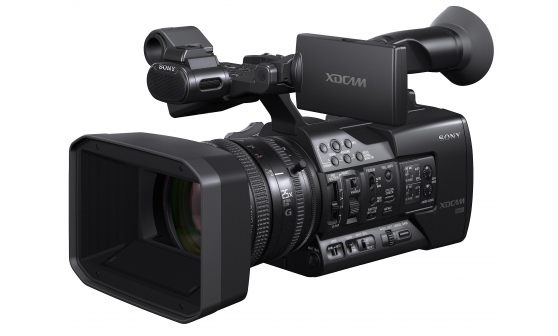
Sony released two new cameras in the XDCAM series of cameras at Broadcast Asia, Singapore, last month. The PXW-160 and 180 both feature 3 1/3"full HD Exmor CMOS sensors. A 25x zoom (26mm-650mm 35mm equivalent) G lens and a world first electronic variable Neutral Density (ND) are two of the stand out features. Full HD XAVC Intra and XAVC Long GOP recordings and MPEG HD 422 50 Mbps offer budget savings and workflow flexibility for broadcast and professional applications. Sony PXW-X160 Camcorder captures Documentary, Reality and Live Events, including handheld applications.
In contrast to the PXW-X180, the PXW-X160 does not have wireless functionality, NFC or GPS, lowering the price but keeping the same level of performance. It can record in XAVC Intra and Long GOP, enabling 10-bit sampling for HD recordings with a long tonal range, and also the MPEG HD422 at 50 Mbps format now used frequently in broadcast and production. It records in MPEG HD420 at 35 Mbps, AVCHD and DV formats as well.
The MXF file format is used for XAVC recording, compressing full-HD 1920 x 1080 resolution using the MPEG-4 AVC/H.264 codec. Image sampling is 4:2:2 10-bit with Intra-frame compression at 112 Mbps, or high-efficiency Long-GOP compression at 50/35/25 Mbps. As the successor of HVR-Z7 and HXR-NX5, the PXW-X160 has a lot of attractive features, including dual SxS memory card slots, and variable ND filter, that provides four conventional mechanical 4 ND filter positions or a linear switch dial for more control in changing light conditions., high resolution, high sensitivity, low noise, and wide dynamic range for enhanced shooting under severe lighting conditions and more creative freedom.
Prices are being quoted in the GBP 3,100-3,700 range.
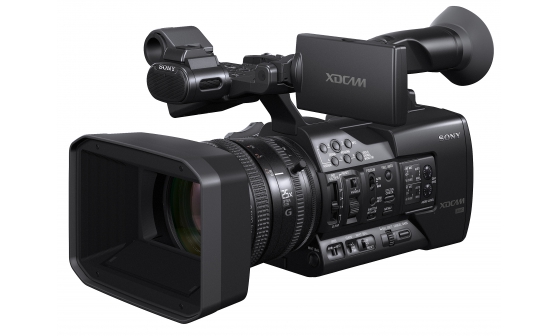
The PXW-X180 three 1/3-inch type Exmo CMOS sensors camcorder records Full HD XAVC Intra and XAVC Long GOP, as well as MPEG HD 422 50 Mbps, MPEG HD 420 35 Mbps, AVCHD and DV, making it ideal for a wide range of applications from education/videography to news and broadcast production. As the successor to the HVR-Z7 and HXR-NX5, the PXW-X180 has a lot of attractive features, including dual SxS memory card slots, proxy recording on SD card, a G Series fixed 25x HD zoom lens with 26mm wide angle and variable ND filter, that provides four conventional mechanical 4 ND filter positions or a linear switch dial for more control in changing light conditions.
Another new and unique feature of the camera is that it’s Sony’s first broadcast camera to feature an internal variable neutral density (ND) filter. This give it the ability to have the N/D adjusted in smooth continues levels from 1/4 to 1/128, instead of the traditional 3 setting N/D wheel. Other features:
*High resolution, high sensitivity, low noise, and wide dynamic range for enhanced shooting under severe lighting conditions and more creative freedom.
*Offers remote control via a smart-phone or tablet computer using a Wi-Fi connection, and recorded video files can be transferred from the camcorder to smart-phone in MP4 format.
*One-touch authentication is also possible with smart-phones that offer NFC connectivity.
*Wi-Fi operation cannot be guaranteed with all smart-phones and tablet computers.
Some sellers are quoting prices around £3,999.00 --£4,798.80+VAT.

Ericsson’s Vision 2020
Ericsson was a star attraction at BroadcastAsia, which attracted over 17,500 visitors from 87 countries. Its booth had attractive young ladies offering cold drinks. I jocularly asked whether they were serving Singapore’s home brewed Tiger beer. One young lady pulled out a can of Tiger and offered it to me. Since it was a joke and I had no intention of consuming that beer, I kept it, to be offered later to someone who would do justice to it. The ne3st day, I dropped into the booth again, and guess what? She was opening the cans, pouring them into glasses and only then allowing visitors to carry it with them.
After the four-day event was over, I came across a piece on the Ericsson website, written by Warren Chaisatien, Head of TV Marketing, Australia and New Zealand, Ericsson, in charge of positioning the company for market technology and thought leadership across the region. I felt it summarised the highlights of the Ericsson participation at BroadcastAsia and also outlined its vision 2020.
BroadcastAsia 2014 review: Collaboration key to success in the TV industry in APAC
Ericsson had a major presence at this year’s show, with activities ranging from on-booth demonstrations of recently launched solutions (including Ericsson Virtualised Encoding and the AVP 1000 stream processor), to thought-leadership seminars and speaker sessions alongside a number of leading TV service providers, broadcasters and industry partners. As I explained to a number of industry delegates, the future of TV lies with efficient video delivery and working towards making every network video-centric. This will be imperative as industry players drive new revenues, reduce costs and understand the most critical elements of the evolving TV landscape.
Evolving TV and video trends in Asia-Pacific
If we look at the APAC region as a whole, we can see that the expansion and availability of broadband is rapidly increasing demand for IPTV and OTT services. According to research by Media Partners Asia, APAC is set to witness a significant rise in fixed broadband subscribers, rising from 310 million in 2013 to 400 million by 2018. The 2014 Digital TV World Revenue Forecast also highlights how Pay-TV revenues are set to grow by nearly $15 billion from 2013 to 2020 – a growth of nearly 50 percent. As the BroadcastAsia tagline alludes, it’s time to ‘Discover the Right Business Model to Harness Technology and Monetise Content.’
These trends form part of Ericsson’s recently launched Media Vision 2020, which outlines our view of the future of the TV and media landscape and the necessary strategies required to deliver success in this new era. Discover more about Ericsson’s Media Vision 2020 here.
Ericsson Media Vision 2020 Roundtable
My Ericsson colleague Simon Frost, Head of TV Marketing, led a roundtable featuring a number of leading telecom operators, broadcasters and content providers from across Southeast Asia and Oceania. As one of the participants on the panel, I was keen to stress how our industry must change and embrace the opportunities and challenges of a rapidly evolving marketplace, which will be worth $750 billion in just six years’ time. By 2020, a new era will emerge, where:
•There are 9 billion people, over 8 billion mobile broadband subscriptions and 1.5 billion homes with digital television;
•OTT services account for 41 percent of the total TV viewing experience, compared to traditional broadcast channels; and
•Consumers in advanced markets will have shifted their patterns to a 50-50 split of the time spent with on-demand and time-shift vs. linear and live TV.
On the path to 2020, collaboration and flexibility will be key as the entire media value chain continues to be reshaped by fresh innovations and shifting consumer preferences. We believe that bringing together relevant industry players to make services as simple, accessible and convenient as possible for consumers to view and pay for will be key to achieving success. Technology and connectivity is enabling interplay between new players and as such, there is a clear need to bring the ecosystem together in order to monetize these new opportunities.
Popularity of true 4K UHDTV at BroadcastAsia 2014
Another of the show’s hot topics was 4K UHDTV, with the on-going World Cup offering a primary example of how the technology can be harnessed for TV audiences in the very near future. We demonstrated true 4K UHDTV end-to-end video transmissions over satellite at our booth. The transmission consisted of live sports programming, with the replayed images encoded using the Ericsson AVP 2000 Contribution encoders. The video was then transmitted from London to our show booth in Singapore, marking APAC’s first live 4K transmission!
The future of 4K UHDTV and adoption rates will be highly dependent upon the way in which our industry presents this technology. Fundamentally, 4K UHDTV is all about the consumer experience. If true 4K UHDTV can be transformed into an immersive, cinematic television experience for the living room, we believe consumer uptake will soon follow. To enable this level of experience, the technology requires 10-bit depth data values for all content, and 50-60 frames per second for sports and other complex motion content.
In the next 18 months, we expect to see a number of highly significant developments that we believe will accelerate the growth of this technology. The emergence of a new Ultra High Definition (UHD) Serial Digital Interface (SDI) later this year and the availability of real-time videos over IP infrastructures (2015+) will see:
•Expanded colorimetry
•A continuation of the higher frame rate debate- can our industry reach 100-120 frames per second?
•The vetting of higher dynamic range proposals
It will be fascinating to see how the growth of 4K UHDTV technology develops by the time BroadcastAsia reconvenes in June 2015.
(Warren Chaisatien’s current focus areas include TV and Media, Mobile Broadband, and OSS/BSS. He is also a Networked Society Evangelist, advancing Ericsson’s vision of a world with 50 billion connected devices.
Warren has more than 15 years of international ICT industry experience in sales and marketing, as well as strategy and consulting, spanning North America, Europe and Asia Pacific. Before joining Ericsson in 2010, he was a multi-award-winning telecom analyst in Canada and Australia, and has written over 100 industry papers. Warren holds a master’s degree in engineering management from Sydney's University of Technology). (continued)


