
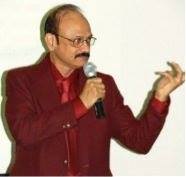
Binaca GeetMala: 70 years ago, this day
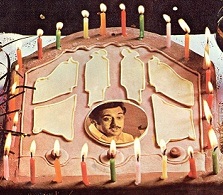
Binaca GeetMala: 70 years ago, this day
You wouldn’t blame me, would you, if I got really nostalgic, even mushy? If you were Ameen Sayani’s only disciple, recently promoted to Chief Copywriter too, what would be your feelings when you realised that the programme you grew-up on, the programme that is just 14 months younger than you, first went on air on the 3rd of December 1952, exactly 70 years ago? And the owner of the voice that thrilled India and Asia, including some parts of Africa, Europe and America, will turn 90, just 18 days from now. Yes, he was 18 days short of his twentieth birthday when Binaca Geetmala (BGM) was first broadcast from Radio Ceylon. And at 90, he is still active and still recording. BGM went on in various forms and formats lasting about 41 years, for many years on Radio Ceylon and, towards the end, on Vividh Bharati. Memories are made of these.
Being the only musical hit parade Hindi film song countdown show on air, it had an audience of millions, perhaps tens of millions. Traffic stopped in most parts of India, and the streets wore a deserted look, on Wednesday evenings, 8-9 pm, because the man known for his ‘Behno aor bhaiyo’ refrain came on air, with 16 of the week’s top hit songs. AmeenSaahab also replied to questions sent by post-cards to the famous address, ‘Binaca, Post Box 439, Bombay 1’. The programme was sponsored by Ciba, a Swiss company that made and marketed Binaca toothpaste in India. Of course, the market-leader was always Colgate, but Binaca sure gave it a run for its money, until it was bought over by Colgate, decades later.
An English version of the programme was already on air, over the same station, Radio Ceylon. The powers that be felt that a Hindi programme would add to their product’s reach, and so they instructed Radio Advertising Services (RAS), Radio Ceylon’s Bombay-based sole advertising agency, to devise a programme in Hindi. Budget was a crunch, and the workload was heavy: writing and presenting the programme and reading and answering listeners’ selected letters. From the retinue at RAS, nobody volunteered, except 19 going on 20, Ameen, younger brother of an RAS director, Hamid Sayani. Ameen’s Hindi was passable at best, Gujarati being his mother tongue. But helping his social activist mother Kulsum Sayani publish a newspaper, Rehbar, in Hindi, Urdu and Gujarati, he had picked up a bit both Urdu and Hindi. Although he volunteered, he had butterflies in his stomach. What if…? All it took was one episode, and the postal response, which was expected in the range of 25-50, crossed 7,000 letters! The rest is history, and is a 41 years stint not history? That’s how long the programme ran.
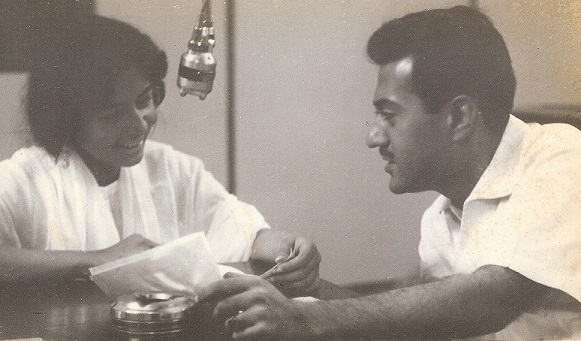
Ameen Sayani interviewing starlet, late Nanda, in the studio of RAS
Why was it broadcast from Radio Ceylon (later known as Srilanka Broadcasting Corporation) and not Vividh Bharati or any of our Indian FM channels? Well, FM is a recent phenomenon and did not exist way back in 1952. Neither did Vividh Bharati, which came into existence in 1957. Yes, we had All India Radio and Akashwani, but under the directive of the Ministry of Information and Broadcasting, Akashwani was not to play any film music. Nor was it allowed to broadcast and advertisements or sponsored programmes. Taking advantage of this situation, a group of people approached Radio Ceylon, which had a powerful Short Wave Transmitter, that could be heard all over Asia, parts of Africa and even some pockets of Europe and, with a proposal to set-up an agency in India, and broadcast spots (short commercial recordings, of 7-60 seconds duration) and sponsored programmes (up to 60 minutes long), promoting both Indian and international products, and Indian films.
Radio Ceylon agreed, for the arrangement would mean an income of thousands of US dollars, as payment would have to be in international currency! They appointed Indians as announcers for the duration of the Hindi service, which was in the morning and evening only. For the rest of the time, the station broadcast programmes in Sinhalese, the national language of Srilanka. Recordings were done in India, on ¼” magnetic spool tape, and sent to Colombo via Air Freight twice a week, and the audio-tapes were then played on the Radio Ceylon machines. Nothing was live, except the Indian announcements of the announcer on duty. Those days, everything was pre-recorded. But the trick was that the pre-recorded programme should sound as ‘live’ as possible. AmeenSaahab excelled at that! Moreover, his lead-ins and lead-outs from songs were so absorbing that the whole hour was an aural treat.
On account of its cult following, BGM gave rise to Listeners’ Clubs across India and even overseas. It also gave rise a speculative activity. Some listeners used to bet on the top song of the week. One such man was the late Ramnik Poojara. He lived on the second floor of the building in which I lived, and was a friend of my brother Riaz, who was to become Chief Copywriter to AmeenSaahab, a decade later. Ramnik, a couple of his friends, and Riaz would take me to a small, hole-in-the-wall café, every Wednesday night at 8 pm. I was all of 8 years old, and their average age was 21. One of them would quietly whisper in my ear, “Which song will top today?”, and I would innocently make a prediction. It turned out correct, 9 times out of 10. Meanwhile, beyond my knowledge, these gentlemen made hundreds of rupees by betting on my predictions. As for me, I was in awe of the presenter, and started working for him part-time during 1970-73 and full-time, 1973 onwards.
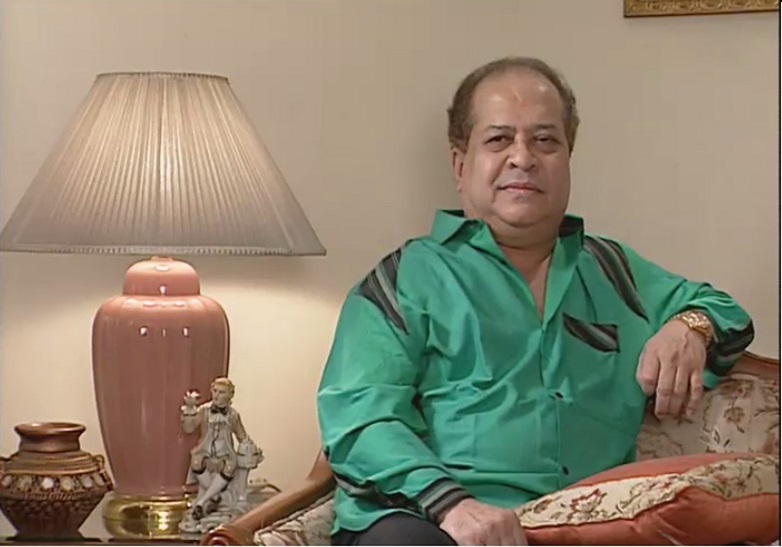
Music director late Laxmikant, of the legendary composers Laxmikant-Pyarelal, on the sets of Cibaca Geetmala
Such was the prestige associated with the programme that music director, the late Laxmikant, went on record to say that the sole motivation behind their (Laxmikant-Pyarelal’s) struggle to become film music composers was to see the day when their song is played in Binaca Geetmala’s hit parade. While some might attribute this remark as being half in jest, the absolute fact, corroborated by Laxmikant’s daughter Rajeshwari, is that the composer, who gave music in 503 films and recorded 2,845 songs between 1963 and 1998, was a die-hard fan of BGM. As a boy, he would stand outside a Hindu hotel in his native village and listen the programme, which the owner generously played on a transistor radio strategically placed on a window, and facing outward, for the benefit of those who could not afford to sit inside and order some food. When he became a music director himself, Laxmikant would listen to the programme every week, on air. And as he became more and more busy, he asked his wife to make a list of all 16 songs played every week, without fail, and studied it meticulously.
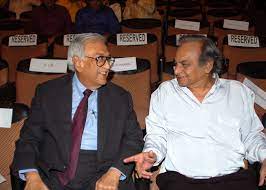
Ameen Sayani, with Anandji
Anandji, the surviving member of the music director duo, who is a few months older than AmeenSaahab, had this to say, when I spoke to him yesterday, “It is amazing that the man who started India’s first music countdown show 70 years ago retains the same charm and the same popularity. For ages, hundreds of compères have imitated his “Behno aor bhaiyo” style. Ameen Sayani gave us India’s first, and only one of its time, barometer of top songs, rivalling the International Top 40 of that era. We used to listen to his programme both before we became music directors and after, first to see which songs are getting popular and later to see if any of our songs made it to the weekly countdown of 16 songs. The programme also showed us what type of songs are getting popular and what are the musical trends. Some of us used to bet which songs will top the chart that week, and we used to maintain meticulous records of the songs played each week. I present my compliments on the 70th anniversary of Binaca GeetMala and wish him many more anniversaries. And I must add that his son Rajil has really looked after him very well and maintained all the records and documents meticulously.”
Along the way, the brand underwent a named change, and was renamed Cibaca. I was asked to announce this fact to a gathering of Binaca tooth-paste and tooth-brush distributors and dealers, who were invited from all over India, and had assembled at Shanmukhananda Hall, Bombay. Naturally, the radio programme also had to change its name, and Binaca GeetMala became Cibaca GeetMala.
First BGM ever
On 3rd Dec in 1952, the first programme of Binaca GeetMala was broadcast. As per a list found in our archives, these were the songs that featured in that programme:-
1) Film Baiju Bawra – song: “Tu Ganga ki mauj main”
2) Film Anhonee – song: “Main dil hoon ek armaan bhara”
3) Film NauBahar – song: “Ae ri main to prem diwani”
4) Film Aan – song: “Maan mera ehsaan”
5) Film Sangdil – song: “Yeh hawa yeh raat yeh chandni”
6) Film Poonam – song: “Jhoome jhoome dil mera”
7) Film Daag – song: “Ae mere dil kahin aur chal”
At that point of time, currently released film songs were played randomly, and listeners were asked to rank them in the order they liked. Songs played were NOT based on popularity ranking. That system came into place a year later.
BINACA/CIBACA GEETMALA
TOP SONGS FROM 1954 - 1993
NO. YEAR SONG FILM
1. 1954 Jayen to jayen kahaan Taxi Driver
2. 1955 Mera joota hai Shree 420
3. 1956 Aye dil hai mushkil C.I.D.
4. 1957 Zara saamne to Janam Janam Ke Fere
5. 1958 Hai apna dil to Solva Saal
6. 1959 Haal kaisa hai Chalti Ka Naam Gaadi
7. 1960 Zindagi bhar nahin Barsat Ki Raat
8. 1961 Teri pyari pyari Sasural
9. 1962 Ehsaan tera hoga Junglee
10. 1963 Jo wada kiya Taj Mahal
11. 1964 Bol Radha bol Sangam
12. 1965 Jis dil mein Saheli
13. 1966 Bahaaro phool barsao Suraj
14. 1967 Saawan ka mahina Milan
15. 1968 Dil vil pyar vyar Shagird
16. 1969 Kaise rahun chup Inteqam
17. 1970 Bindya chamkegi Do Raaste
18. 1971 Zindagi ek safar Andaz
19. 1972 Dum maaro dum Hare Rama Hare Krishna
20. 1973 Yaari hai imaan Zanjeer
21. 1974 Mera jeevan Kora Kagaz
22. 1975 Mehngayee maar gayee Roti Kapada Aur Makaan
23. 1976 Kabhi kabhi Kabhi Kabhi
24. 1977 Husn haazir hai Laila Majnu
25. 1978 Ankhiyon ke jharokhon se Ankhiyon Ke Jharokhon Se
26. 1979 O saathi re Muqaddar Ka Sikandar
27. 1980 Dafliwaale Sargam
28. 1981 Mere angne mein Laawaris
29. 1982 Angrezi mein kehte Khuddar
30. 1983 Shaayad meri shaadi Souten
31. 1984 Tu mera hero hai Hero
32. 1985 Sun sayba sun Ram Teri Ganga Maili
33. 1986 Yashoda ka Nandlala Sanjog
34. 1987 Chithhi ayee hai Naam
35. 1988 Papa kehte hain Qayamat Se Qayamat Tak
36. 1989 My name is Lakhan Ram Lakhan
37. 1990 Gori hain kalaiyan Aaj Ka Arjun
38. 1991 Dekha hai pehli Saajan
39. 1992 Main ne pyaar tum hi se Phool Aur Kaante
40. 1993 Choli ke peechhe Khalnayak
On the 12th of December, 1977, BGM celebrated its silver jubilee, and did it in style. I was asked to deliver invitations to the who’s who of films and music, and also to procure the reels of the songs, ‘Zaraa saamney to aao chhaliye’ (Janam Janam Ke Fere) and ‘Jis dil men basaa tha’ (Saheli). The idea was to project the top songs of the years, 1953-1977. Since this was before the video recording, DVD and pen-drive era, the songs had to be on celluloid film positive. 1977’s topper would be revealed that night, on the screen, and not on radio, as was the norm. Reels of most of the films were available, but those of Janam Janam Ke Fere and Saheli were not. I got in touch with Manmohan Desai, son of the producer of JJKF, Kikubhai Desai, and top producer-director in his own right, and somehow, we managed to get the reel. The producer of Saheli had passed away and his son, who was a book publisher, was not interested films. Yet hard work and persuasion prevailed, and he arranged for a film copy of the song.
On the big day, AmeenSaahab patted my back and said, “I must say you worked really hard for this event.” I was elated. But that did not prevent me from fainting a couple of minutes later, in the green room, due to sheer exhaustion. As a result, I missed a substantial part of the proceedings on stage. Later, HMV issued a two-album set of the 25 songs that constituted Binaca GeetMala’s Silver Jubilee list. AmeenSaahab gave me an autographed copy, something I treasure.
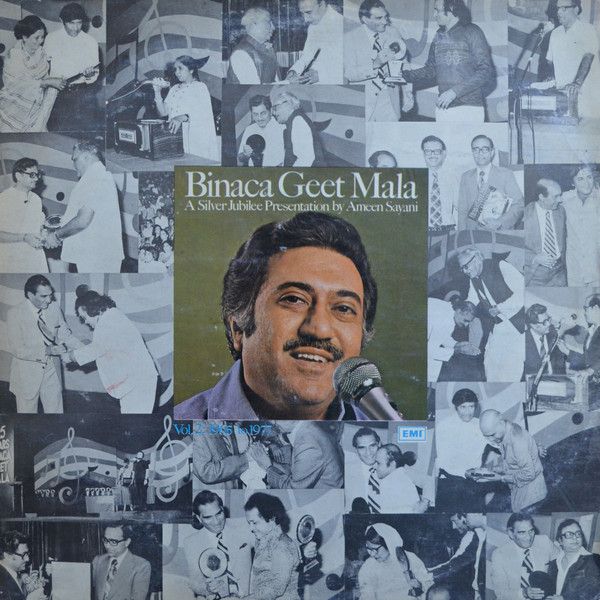
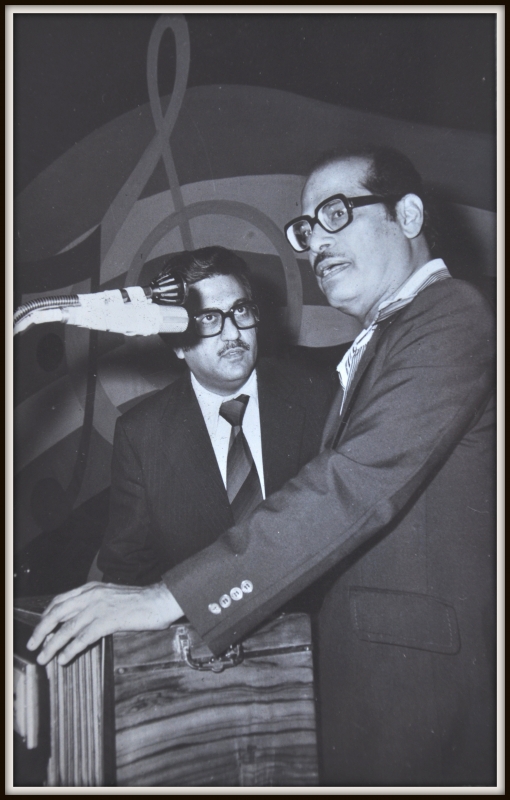
Ameen Sayani and Manna De at the Silver Jubilee of BGM
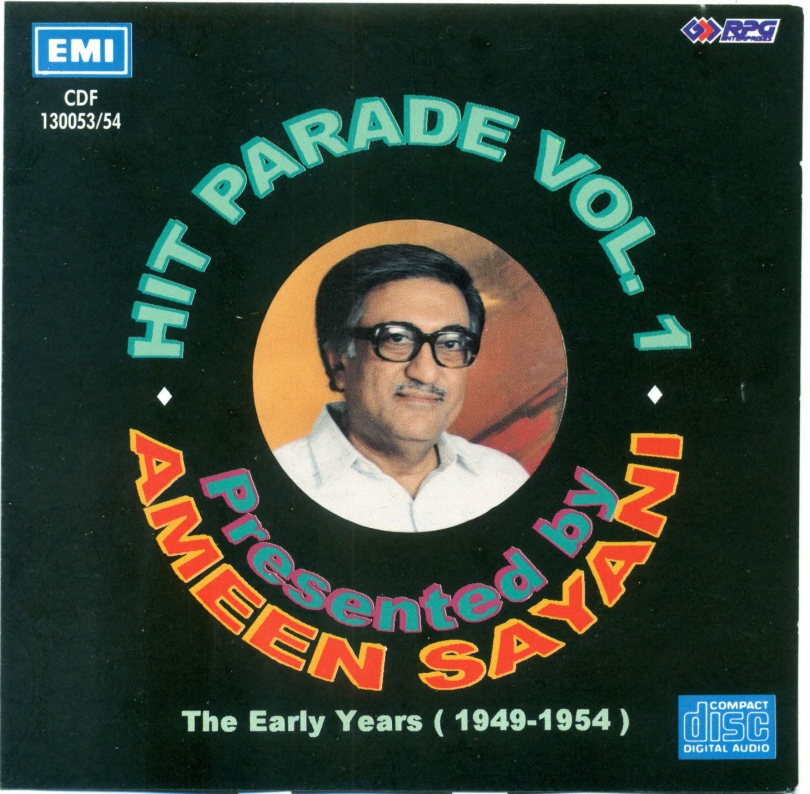
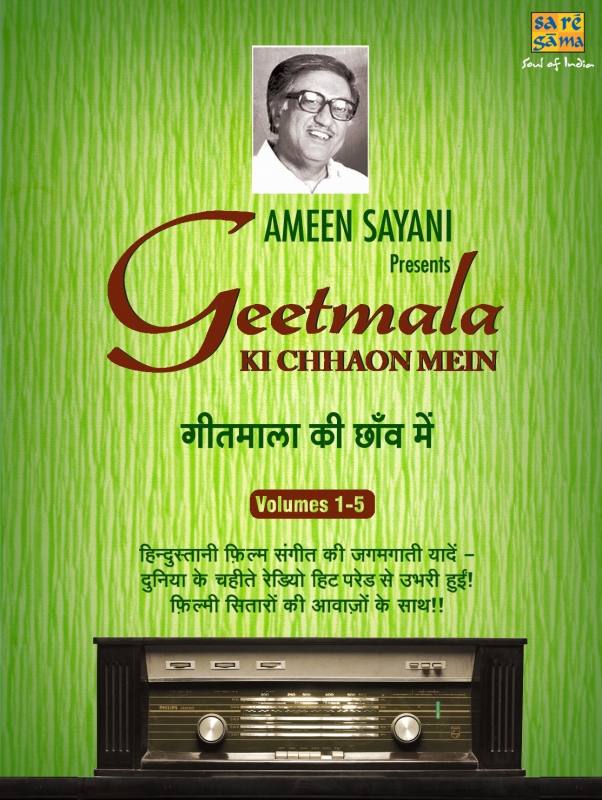
Although 1993 marked the end of an era, AmeenSaahab continued to make his presence felt in the media, all through the 1990s, 2000s and 2010s. This was through television (Cibaca GeetMala), Hit Parade series on LP records, HMV GeetMala Hit Parade series on audio-cassettes, GeetMala Ki Chhaon Men on CDs and Saregama’s portable digital song bank, Carvaan, which has a major part contributed by Ameen Sayani. He also either appeared on screen, or lent his voice, in as many as 20 films, beginning 1963, the last one being the remake of Coolie No. 1 (2020).
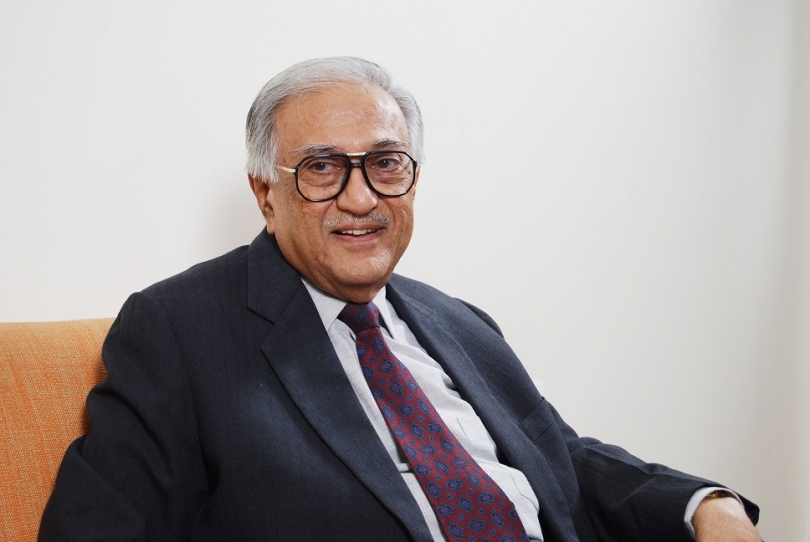
I was lucky enough to do commercial recordings with him in as recently as in 2018 and 2019, with scripts written by me. Another one is coming up soon, which I have written, and which he and I will lend our voices to, in 2022 or early 2023. Happy birthday, Binaca Geetmala and coming-up...Happy 90th birthday, AmeenSaahab.


