
Why We Will Always Love Philip Seymour Hoffman, Despite Love Liza
by Quendrith Johnson, Los Angeles Correspondent
Movie star deaths have a history of press problems, Philip Seymour Hoffman (1967-2014) was found on Superbowl Sunday dead in Manhattan; Groucho Marx's death on Aug. 16, 1977 was overshadowed by Elvis Presley's death a mere three days later on Aug. 19, 1977. Farrah Fawcett died June 25, 2009, in Santa Monica, the same day as Michael Jackson, June 25, 2009, in Los Angeles. Legendary actor Maximiliam Schell (1930-2014) died on Saturday, Feb. 1, in native land Austria, then Sunday, the (non-Dustin) Hoffman.
None of these actors had their fair share of public mourning.
So it makes sense to take a moment to consider the life of Philip Seymour Hoffman in all its complex facets, without resorting to the last sordid details of the way his body was discovered.
He was born in Waterloo, New York, attended the Tisch School at NYU and was seen by many as the quintessential "New York actor." He did "Hollywood," but he was a "real actor," as they say.
Not too long ago the revered Mike Nichols was directing Hoffman in Arthur Miller's "Death of a Salesman," which is to any actor the pinnacle of the craft - both under Nichols' direction and a work by Miller.
"There are no words for this," Mike Nichols said, when they force-quoted him on the shock death.
Opposite Joaquin Phoenix in The Master, Philip Seymour Hoffman out-shined the script like a master himself, dropping just enough oddity and brash into the role that he was note-perfect once again. In 2011's Ides of March, he played a politico who gets ambushed by his own protege Ryan Gosling.
George Clooney took the rare dark role in Ides, and Hoffman was the rare good-guy-who-got-screwed.
While fairly consistently playing heavy and complex, Hoffman could do funny, and shy. But there was his real-life "fragile" side, that apparently everyone who knew him, most notably Diane Lane who mentioned this side of him recently, saw first-hand. Despite the veteran actor's hulking later life physique, having lost then gained a lot weight, he gave off a breakable vibe somehow to those who worked with him.
Hoffman did have the rare career misstep, the unwatchable Along Came Polly in 2004 with Ben Stiller. That movie was nominated for a Razzie, but he could not be maligned for his part in the clunker. Always a pro, as they say.
What we will remember about Philip Seymour Hoffman is that he won an Oscar for Capote, and turned around excellent performances in Ides of March, Moneyball, The Hunger Games: Catching Fire, and will always be part of the cult casting of The Big Lebowski directed by the Coen Bros. He played the fawning yes-man, Brandt, brilliantly to the Big Lebowski himself, David Huddleston.
"Those are the urban achievers, children without the necessary means, necessary means to go to college," Hoffman says, as he disingenuously takes Jeff Bridges on a tour of the fame wall in "the other Lebowski's" mansion.
Gwyneth Paltrow, who starred with Hoffman in The Talented Mr. Ripley with Matt Damon, has eulogized the actor as a "true genius," and Rolling Stone has just done a post-mortem on him as a palliative for its readers.
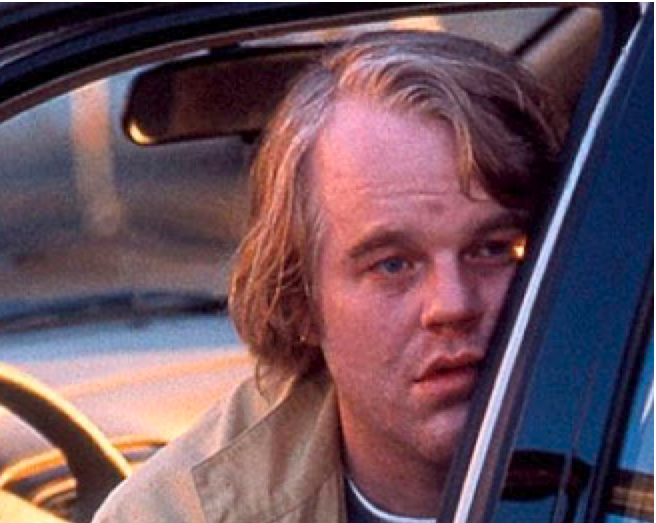
But the backstory of Philip Seymour Hoffman's real life can be seen on public display in the 2002 movie Love Liza, where he plays a man who is inexplicably addicted to "huffing" gasoline fumes to get high.
Chillingly, the Rex Reed poster-quote reads: "LOVE LIZA could do for Mr. Hoffman what LEAVING LAS VEGAS did for Nicolas Cage."
In that role, Mr. Hoffman told us everything we needed to know about his off-camera struggles, but we were probably too entranced by his talent to perceive what it all meant. Substitute a class A substance for gasoline, and the picture is loud and clear.
In the end, this fine actor was nominated for at least five Oscars, won the top prize as headliner in the story of Truman Capote, and gives us all pause.
Philip Seymour Hoffman had all the talent, all the accolades, and apparently a lot of heartache to go with it. He was one of us, and not one of us, a complicated generous melancholy player who strutted and fretted a little too much then died way too soon... So ignore the sensationalist press on his death, remember the actor and the man.
UPDATED - Best tribute quote, from Javier Bardem: "I mean, Philip Seymour Hoffman, for me, is one of the most amazing actors of all time. There's no one moment of not truth in his performances. I go to the away, blown way with everything that he does." - Javier Bardem, Oscar acceptance speech 2008, No Country for Old Men from www.screenmancer.tv/JavierBardem.htm
# # #


