
The Museum of PreCinema in Padua, Italy
Painted tin early Magic Lantern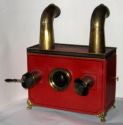
Museum of PRECINEMA in PADUA, Italy
Located a good drive from Venice, is one of the most unusual testimonies on the history of motion pictures,
the Museum of PRECINEMA in Padua. Termed a 'museum of wonders', it was set up in 1998 by the Commune of Padua and the Minici Zotti Collection, as a private-public joint venture. The starting point begins with the the Lumière
brothers depicting the development of machines
made for vision and optical
entertainments which led ultimately to filmmaking.
Enshrined in the 15th century Palazzo
Angeli in Prato della Valle, in the historical centre of
Padua, the display features optical instruments and original
hand-painted slides going back to the 18th and
19th centuries.
Peepshoows and optical views, a
collection of optical instruments and toys, illustrate the attempt to get the picture rolling of stills, a favourite pastime in in Victorian times. Devices vary from simple to more complex machines..
Since 1975,
Laura Minici Zotti, skilled lanternist and director of the
museum, has spread knowledge of the PreCinema throughout the world, giving her
magic lantern shows. She uses both an English bi-unial model
(about 1880) and small (3 sq.in.) hand-painted lantern slides (19th
century)Laura Minici Zotti, lanternist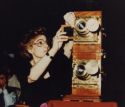 Laura, the lanternist
The show program is frequently changed to prevent deterioration of the
pictures, but also to demonstrate the whole Victorian repertoire to the
public.The main purpose of the shows is to recreate the lives of famous
personalities of the past, by means of the best of the thousands of
slides contained in the collection.
Recently the Museum's curator, Laura Minici
Zotti, received the Seal of the City of Padua
and above all the important international Jean
Mitry Prize 2008 from the 27th Pordenone Silent
Festival for her constant reserch and
dissemination in the cultural field.
The photography
exhibit has some amovible megalethoscopes to finely hone the images and original
hand-held or
column stereoscopes show images in three dimensional form, as well as one device illustrating a
360° photo-view hereunder of
the Prato della Valle.

Of particular interest are the different kinds of magic lanterns from the 18th
century to the birth of Cinema,
including the legendary Phatasmagoria Magic
lantern, and the J. H.
Steward tri-unial in mahogany
with brass lenses dated about 1880. TOY LANTERNS shown feature painted tin,
made by Lapierre, Plank and Müller,
and French-made "salon"
lanterns.


