Hidenori Sugimori's Holy Waters
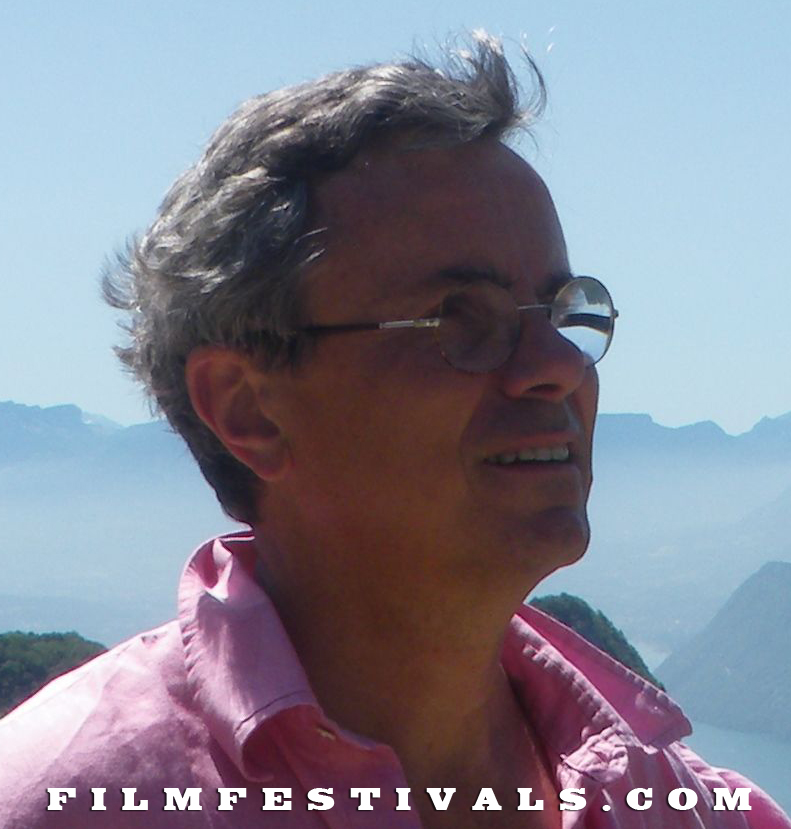
If a Buddhist monk made movies, he would probably be Hidenori Sugimori. "I
was probably a monk in my past life," says the director with a laugh. "I
wanted to make a Zen, meditative film," he added about his feature debut
Mizu no Onna. The film, which stars two music stars in Japan, Asano Tadanobu
and UA, is an esoteric love story between a woman who can control the powers
of water and a man who cannot quite control the inner fire that haunts him.
We met director Sugimori at Venice 2002. Mizu no Onna just won the Thessaloniki
Film Festival Best Feature Prize.
How did you get interested in cinema?
I have always been interested in cinema… Cinema is my teacher in life…
Cinema has taught me what life is, what love is… French cinema is especially
important to me. Like Jean Renoir. I respect him very much. The title of my
debut film means "Water Woman". It's very similar to Jean Renoir's
debut film, La Fille de l'Eau (Whirpool of Fate, 1925) I'm honoured !
(Laughs) The title is very similar! For me, he is the greatest director. He
taught me many things, what life is. I want to make films like Jean, but it's
very difficult. He's a very talented man and I have not talent!
Also, I'm Japanese, and we Japanese people can't express love like Jean Renoir
in his movies. He expresses love freely, it's a positive force. Many Japanese
people are very shy, don't speak out. So I can't express love like Jean, but
hopefully I can shoot water like him. Jean Renoir was attracted to water. Many
of his films are about water. In Picnic on the Grass, there is a wonderful
river sequence. Also, he shot swamp waters and rivers in India. He had been
attracted to water, just the same as me. To me, water is a very important element
in cinema.
In that respect, did you try to shoot Mizu no Onna during the rainy
season in Japan?
(Smiles) At first, I tried to do that, but it proved impossible. So all the
rainfall in the film is artificial. (Smiles) That was very difficult. It needed
time and budget. But my staff was very skilful.
What kind of films did you shoot at the Waseda University where you studied
film?
I shot "Grey", which was an experimental story. It was very
minimal. Just one guy wandering in Tokyo every night. He can sleep every day,
so he wanders in Tokyo every night. I wanted to film the interaction between
the city and this man.
It is said that you traveled extensively in India and Nepal. Can you tell
me why?
Now I live in Tokyo, a very busy city. We are always influenced by time, by
what we have to on the spur of the moment, etc. But if we go to India, Nepal,
Tibet, we can forget about time, about the cutting edge, what is up-to-date,
etc. We can get a different sense of time and our place in the universe. That's
the reason I traveled there. I have traveled during one year in India. I even
received my invitation to the Venice Film Festival while I was in India ! (Laughs)
Now, I meditate more than one hour every day. That's my life, you know. It's
very important for me, because I lost myself in the urban world. I needed to
get myself more in tune with time as it flows in the universe.
So how could you ever work as hard as you did, shooting so many commercials
and TV series? Didn't you think about spirituality at that time?
No, I always thought about spirituality, since a very early age. Maybe I was
a monk in my past life! (Laughs) So I always wanted to inject some spirituality
into the commercials or TV programs that I made. I think we need some power
or spirituality in life, but we forget about that. Ancient people thought about
spirituality every day. That's a nice custom, I think.
But there are still spiritual areas in Japan. If you leave Tokyo and go
north or south…
(Shakes his head) No. Well, some places… Around the Mount Fuji. Some shrines.
I feel that. But there are very few places.
What was your first idea for the script of Mizu no Onna?
I wanted to make a good drama. But this meant a story between two persons.
I wanted to try and make a film about the relationship between man and nature.
Or man and the universe, man and God, something like that. In ancient Greece,
stories were mainly about man and the universe. Nowadays, I think there are
no more myths and stories about man and nature. But we need that. Especially
in the new century. So I wrote this story about four characters that represent
four elements.
The first one is the Water Lady. She lives flexibly, like water. The Fire Man
lives passionately, like fire. The Wind Lady lives freely like the wind. The
Earth Lady lives down to earth. So those four characters represent the cosmos.
That was my idea. You know, Shohei Imamura regards human beings as animals,
and Luis Bunuel as insects. For me, I regard human beings as phenomenons of
nature. So I want characters that symbolize nature. And the actors and the background
are just the same. In my film, the rain is " acting ". The mountain
is an actor. This is my style in a way.
The film also seems to be about how UA, the Water Woman, can't heal the
fire of Yusaku, because the fire devouring him is too strong.
Yes, but no element is stronger than any other. The most important thing is
the balance between the four elements. Towards the end, the balance changes
a little bit and the story veers towards tragedy. This means that encounters
can be fortunate or unfortunate, but the balance has to prevail in the end.
Why make the character played by Asano Tadanobu an arsonist?
We all have the element of fire within ourselves. Fire is necessary for us.
It makes light, heats meals… We need it to warm our bodies. But if we lose
control of it, fire will destroy us. Asano Tadanobu's role is just like this.
He always lives quietly, like a small fire. But from time to time, he turns
into a big fire. Like the world. I think people are always two-sided. Some people
that are quiet can suddenly burst into big fits of anger. So I wanted to talk
about the two aspects of fire with Asano Tadanobu's character.
How did you convince Nikkatsu to finance your film?
The producer Nikkatsu is a friend of mine from the Waseda University. This
made things much simpler.
You wrote the character of the Water Woman specifically for UA. Tell me
why.
There are two reasons for that. First of all, it's very difficult to make a
debut film in Japan, you know. The reason I retired from television is I wanted
to make a feature film, of course. But there was no opportunity for me. So I
wrote many versions of the film. I showed the scripts to companies, but all
they said was: " It's too big for a debut film." So I thought, 'OK,
I have to change my plans, it's not good to show scripts to companies.' I had
a connection with UA, who is very popular in Japan. So I thought, 'If she likes
the script, then afterwards I can say to the companies that this actor or this
actress loves the script, so why don't you shoot this one?' UA is a very popular
singer in Japan, she's very talented, and she's a fashion leader. So I wrote
the part for her. The other reason is, she's a very nice woman. She likes movies
very much. She studied film.
So you changed many elements in the script?
For instance, the old lady. In the first version, she talked very much. Now
she doesn't, because she is the Ground Lady and the ground can't speak! (Laughs)
She is a very famous actress. She played in Shohei Imamura and Shuji Terayama's
films. She is mainly a stage actress. I respect her very much.
Tell me more now about the bathhouse where the film is set.
It was closed 3 years ago. It was in bad condition. The owner let us do it
up. So we changed it totally. We drew the Mount Fuji, changed the tiles on the
floor, the walls. But still, it was very difficult to shoot. The bath system
was out of order. There was no more water. So we had to make hot baths by ourselves.
We had to bring water in a tank truck and shoot fast, because the water level
diminished rapidly! (Laughs)
Did that push the budget up?
…It was difficult. (Laughs)
In the film, you use water in many ways… There's a very touching scene
where UA caresses the water, and the water takes different shapes.
Yes, this is not a computer effect. It was made on the set. It's a water machine
designing water lines, and you can change the shape of the line. It's not digital.
I didn't know this machine. It's used for water spectacles.
What do you like about Asano Tadanobu?
He is the leader of the "Nouvelle Nouvelle Vague" in Japan. He's
the leader. He's very quiet, but he can express many different emotions. I wanted
to make this film in a very quiet way, like a Zen movie. A great American filmmaker,
Samuel Fuller, said "Movie is emotion". I agree with him of course,
but I wanted to try and express another aspect of film. Not only emotional but
also "meditative".
What was the overall shooting experience like, given it's your first feature
film?
I'm so happy. It was my dream come true. Now I'm a member of the film community,
it's wonderful.
The music is by Yoko Kanno, who is very well known for animation soundtracks…
We worked together many times on commercials. She is so talented. She's had
no musical education, but she can write a score. It's unbelievable.
Did you ever have the opportunity to take a bath during the shooting?
Of course! (Laughs) But it was very cold! We shot the film at the beginning
of the winter, in October. You can see the steam in the bathhouse, but it's
not real, it's an effect! So the extras were very cold! (Laughs)
Robin Gatto