

Holy Motors: Review by Moira Sullivan
Holy Motors, a film presented in the official selection yesterday at
Cannes, is probably in a class of its own and has caused a lot of
discussion. It does need to be discussed, however, and maybe it is the
best thing to happen to the Cannes Film Festival competition this year.
It is beyond the character-driven narratives of the official selection
and is a cinematic rarity.
Leos Carax' dystopia set in Paris is about a man whose job is assuming
many identities and playing many roles each day. In the morning,
Monsieur Oscar (Denis Lavant), a middle aged businessman, is picked up
in a stretch limo. He leaves a beautiful mansion and is chauffeured by
Céline (Eva Scob) all day. On his seat is a notebook with his first job.
Some of the assignments include going to the Père-Lachaise cemetery
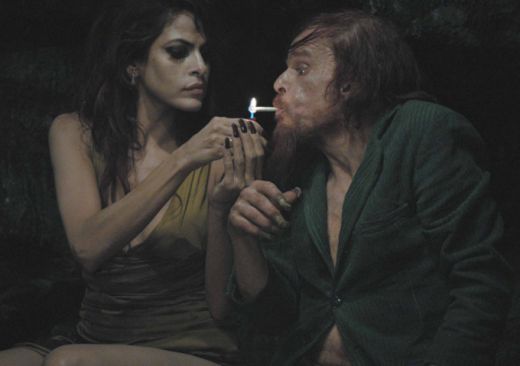
where there is a photo shoot of a beautiful model (played by Eva
Mendes). Monsieur Oscar now wears a red wig and has one false eye and
grotesque fingernails. He is barefoot and walks with a cane. The
photographer is so taken by the man that he asks to photograph him along
site “Beauty”, as "the Beast". He bites the fingers of the
photographer's assistant and kidnaps "Beauty". Then he takes her
underground where he dresses her in a burka. She does not protest, and
he lays his head on her lap.
Monsieur Oscar is also a father with a daughter who he picks up from a
party where she has hidden in the bathroom, a murderer who kills someone
who looks like him in a garage, and an old man taking his last breath.
Some of the scenes are so exquisitely composed that they are
mind-boggling. Many parts of Paris such as Père Lachaise are the sites
for various assignments, and symbolize different epochs of architecture
such as the Notre Dame, the Eiffel Tower, and tract homes outside Paris.
The film clearly is an affront to motion capture cinematography with
Monsieur Oscar in yet another identity dressed in a suit with dots
enacting scenes that will later be made into video games and virtual
reality. Leos Carax seems quite indifferent to this change in
filmmaking. Kylie Minogue plays a woman who has the same job as Monsieur
Oscar. They have only 20 minutes together and she sings a morose song.
Mr. Carax, after a long absence from the screen, has made a visually
stunning film with foreboding messages. The film is entirely subjective,
but in French “motor” means “action” on a shoot. The entire film thus is
a shoot with different sets. Here, in this two - hour film, we witness
the death of cinema, the death of pop culture, the death of
industrialism, and the death of gender and the death of identity.
Because of its artistic content it will probably not open at a local
cineplex anytime soon, but is a feast for cineastes who want an
experience and to assemble meaning in film rather than having it already
prepared.
The critical response to the film was below average, as was expected
with high acclaim too. It opens in France on the French national
holiday, Bastille Day. Viva la Carax!
Holy Motors, a film presented
in the official selection yesterday at Cannes, is probably in a class of its
own and has caused a lot of discussion. It does need to be discussed,
however, and maybe it is the best thing to happen to the Cannes Film Festival
competition this year. It is beyond the character-driven narratives of the
official selection and is a cinematic rarity.
Leos Carax' dystopia set in Paris
is about a man whose job is assuming many identities and playing many roles each day. In the morning, Monsieur Oscar (Denis Lavant), a middle aged businessman, is picked up in a stretch limo. He leaves a beautiful mansion and
is chauffeured by Céline (Eva Scob) all day. On his seat is a notebook with his first job. Some of the assignments include going to the Père-Lachaise cemetery where there is a photo shoot of a beautiful model (played by Eva Mendes). Monsieur Oscar now wears a red wig and has one false eye and grotesque fingernails. He is barefoot and walks with a cane. The photographer is so taken by the man that he asks to
photograph him along site “Beauty”, as "the Beast". He bites the fingers of the photographer's assistant and kidnaps "Beauty".Then he takes her underground where he dresses her in a burka. She does not protest, and he lays his head on her lap.
Monsieur Oscar is also a father with a daughter who he picks up from a party where she
has hidden in the bathroom, a murderer who kills someone who looks like him in a garage, and an old man taking his last breath. Some of the scenes are so exquisitely composed that they are mind-boggling. Many parts of Paris such as Père Lachaise are the sites for various assignments, and symbolize different epochs of architecture such as the Notre Dame, the Eiffel Tower, and tract homes outside Paris.
The film clearly is an affront to motion capture cinematography with Monsieur Oscar
in yet another identity dressed in a suit with dots enacting scenes that will later be made into video games and virtual reality. Leos Carax seems quite indifferent to this change in filmmaking. Kylie Minogue plays a woman who has the same job as Monsieur Oscar. They have only 20 minutes together and she sings a morose song.
Mr. Carax, after a long absense from the screen, has made a visually stunning film with foreboding messages. The film is entirely subjective, but in French “motor” means “action” on a shoot. The entire film thus is a shoot with different sets. Here, in this two - hour
film, we witness the death of cinema, the death of pop culture, the death of industrialism, and the death of gender and the death of identity. Because of its artistic content it will probably not open at a local cineplex in anytime soon, but is a feast for cineastes who want an experience and to assemble meaning in film rather than having it already prepared.
The critical response to the film was below average, as was expected, but that did not prevent some high acclaim. It opens in France on the French national holiday, Bastille Day, July 4th.Viva la Carax!


