Death of the Berlin Catalog
Death of the Berlin Catalog and Navigating the City Geography
By Alex Delon
The Last Berlin Catalogue is now a Museum Piece
A significant change in the Berlinale infrastructure this year was the absence of the traditional catalogue. Long a hallmark of the festival and a collectors item for journalists with detailed reports on every single festival film long or short, capsule biographies of all directors on every page and sample filmographies, all in German and English, so that it constituted something like a bilingual encyclopedia of the yearly offerings and current state of international cinema.
Once upon a time it was distributed free to accreditated press members but in recent years with rising publication costs it was on sale for €25, still a bargain price considering the richness of the content.
This year when I went to pick up my festival bag and press kits I was shocked to find that the catalog information is now available only On-line (aargh) and even the usual festival tote bag, again once a recognizable symbol of the festival, was now a shabby gray shopping bag not worth holding on to.
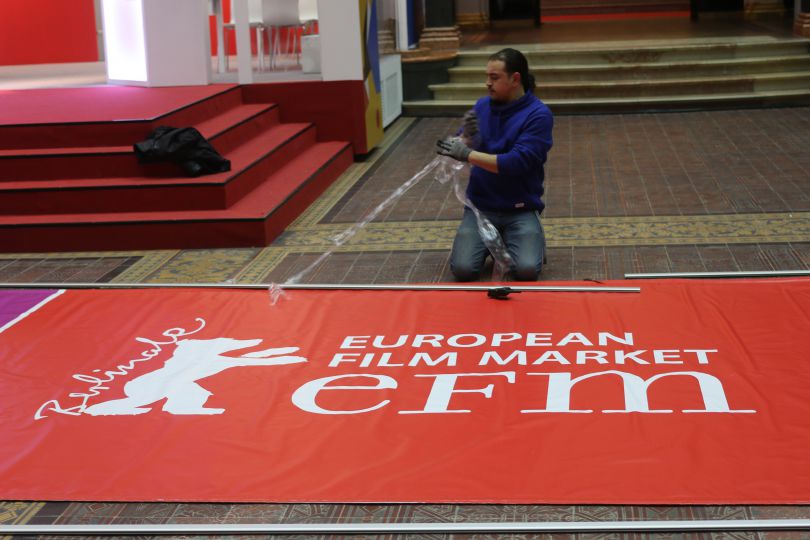
In a way the discontinuation of the festival catalog was a blessing in disguise. Only two other festivals I know of, Cannes and Venice, publish such meaty catalogues on so many films, however -- the down side of this is that the catalogue while loaded with enough film information to keep one busy reading for the rest of the year, is also a load in terms of earthly gravitation weighing in at something like three kilos. The 2015 catalogue ran to 416 pages printed on thick quality paper and was simply too heavy to carry around every day as lighter more compact screen brochures are Laying around all over the place, not to mention daily editions of the main trade papers, Variety, Screen International, and the Hollywood Reporter which provide complete daily schedules for the festival proper and and the EFM, European Film Market, housed in the architecturally listed Gropius Building half a mile away. With the fabulous catalogue now history the old catalogues such as the one pictured here have are sure to become museum pieces.
Since a visit to Gropius to find out what else in new in commercial world cinema requires at least half an hour side trip each way and can seriously interfere with necessary film viewing in the Potsdamer Platz festival center, many EFM companies have now set up offices in the Marriott Hotel which in in the center of things and much more accessible.
Simply navigating the widespread outlying film venues such as the magnificent Zoo Palace cinema in distant West Berlin, or the International cinema on Karl Marx Allee in East Berlin a whimisical reminder of the days when a wall divided Berlin in two politically opposed halves, or the Cubix complexes on Alexander Platz under the soaring ball of the TV Tower rising over East Berlin, or the Zeug Haus cinema in Unter den Linden, can become a formidable job in itself, so one tries to stick to films in the immediate vicinity of the festival center at the Grand Hyatt Hotel, in the Cinemaxx and Cinestar multiplexes which are taken over by the festival during the ten day film marathon. However, because of packed schedules of overlapping screenings, trips to the Provinces of Charlottenberg and Alexander Platz are often unavoidable if one really wants to get to every film on ones "must see" list. The Zoo Palace, completey remodeled, is definitely worth a lengthy metro journey, even if the film turns out to be a loser, because, with first class reclining berths and ample leg room, this is arguably the most comfortable movie house on earth --ideal for catching up on lost sleep if the film is boring, as so many festival selections are.
Another out of the way venue is the creaking at the joints old Friedrichstadt Palace --cavernous and laid out like an open bull ring with a gigantic stage, but a torture chamber with hard wooden seats and cramped leg room. I nearly passed out there trying to squirm through David Bowie's "The Man Who Fell to Earth" in a back row squeeze at the beginning of the week -- and yes, both Palaces, Friedrich and Zoo, have red carpet galas on most freezing nights, because there are just too many galas to handle at the Classy Berlinale Palast festival center on Marlene Dietrich Platz.
One chap I met, an Iranian film historian from London, had the good sense to spend the entire festival at one single projection room, the cushy Cinemaxx 8 way upstairs in the Cinemaxx Building. This room is devoted exclusively to the showing of old classics. Wish I'd had the good sense to follow suite, although I did see a couple of marvelous films there during the week, Ozu's digitally restored "Late Summer" (BAKUSHU) and the DDR classic, "The Russians are coming", to be reviewed later.
Alex, Hotel Alper
Fed. 25, 2016
ALEXFARBA FILM WEBSITE: